AI automation services
AI automation services Automate the repeat, keep the decision
I turn the jobs your team repeats every week, such as form leads, reports, follow-ups and content prep, into AI-assisted workflows. We map the flow together, I build it, and the human checkpoint is agreed before anything goes live.
The approach
What AI automation does, and how I work
AI automation connects the steps of a repeating job with software and hands the steps that need judgment, such as sorting, summarizing or drafting a reply, to an AI model. Everything else stays rule-based: where the record goes, who gets notified, where the flow pauses for approval.
I start with the job, not the tool. Before building anything, we measure how long the job takes today, how often it repeats and how many corrections it needs. If you don't measure it first, you can't tell whether automation made it faster.
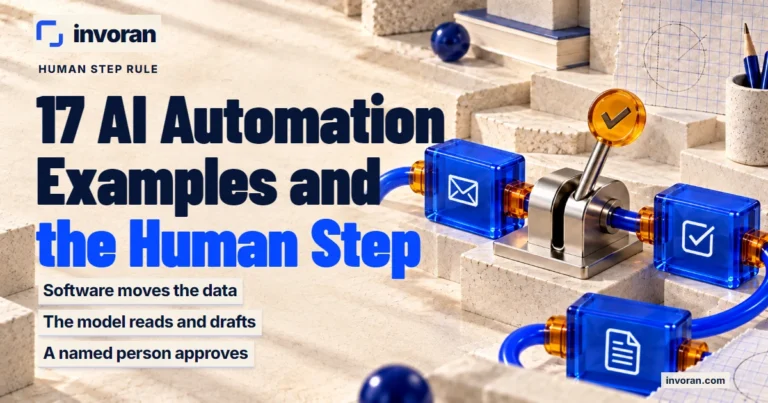
Every flow keeps at least one human checkpoint with a named owner, a fixed place in the flow and a clear job. I call it the Human Step Rule. Anything that goes to a customer, or contains a price, a claim or personal data, passes that step before it's sent.
The tool comes last. Sometimes the built-in rules of your email or spreadsheet tool are enough. When they aren't, we pick a platform such as Zapier, Make or n8n based on the job and on who will maintain it, and I write any code the flow needs with Claude Code.
Automation pays off through repetition. A weekly job earns back the setup effort every week; a job you do twice a year is usually better served by a well-written checklist. I'll say so before we build.
Automations need maintenance after launch: connections, data formats, model versions and business rules change, and the flow has to be retested when they do. That's why every handover includes a written flow document and a note of who checks what.
If you'd rather your team built and ran its own flows, I teach the same method on your own work in my hands-on AI training.
The process
How we build your first AI automation
We start with one job, not a transformation program. Every step produces something written down.
- 01
Pick the job and measure it
We choose one job that repeats at least weekly in the same way, and note how long it takes, how often it runs and how many fixes it needs today.
- 02
Write the steps
Input, steps and output, one under the other. Each step is marked "automation" or "human". That page becomes the build document.
- 03
Name the human step
Who checks, at which point in the flow, against what? If that person is away, does the flow wait or stop? We decide before building.
- 04
Build with the simplest tool
Your existing tools' rules first, a platform only if needed. The AI step goes only where free text has to be interpreted.
- 05
Run a two-week pilot
We compare time, number of fixes and how often the flow broke against the previous weeks. If it holds up, we move to the next job; one flow at a time.
Example flows
Which jobs suit AI automation? Examples from my own work
The first three are flows I run in my own work and for the brands I work with; the fourth is an illustrative example, not a client result.
Outreach and follow-up
Drafts come from ChatGPT; the recipient list is finalized only when the client approves it. Before a follow-up, the record is checked for replies, refusals and bounces, and replies and meetings are tracked rather than sends.
Short-video production line
Images, voice and music come from different AI tools; editing, subtitles and assembly are done with Claude. Script approval, real product footage and the AI label stay human on every video.
Weekly reporting
Google Analytics, Search Console and Ubersuggest data is collected in the same format every week, with each number's source and date range. Collecting suits automation; interpreting and deciding stays with a person.
Form lead to draft reply (illustrative)
A website form submission lands in a sheet; the AI sorts it into price question, technical support or partnership and drafts a first reply. A person checks and sends it.
Deliverables
What's included in my AI automation services
The scope of each flow is agreed in writing before we start. These are the parts every project shares:
- A shortlist of candidate jobs, checked for frequency, steps, input format and whether mistakes can be undone
- A written, step-by-step flow document: input, steps, output and the human step
- The build, using your existing tools' rules or, where needed, a platform such as Zapier, Make or n8n
- A decision on what data the AI step sees and what it doesn't
- A two-week pilot with an error log and a before-and-after comparison
- Handover of the flow document, access details and maintenance notes
Limits
What I don't hand to automation
AI can draft these; a person always makes the final call.
- Price quotes, discounts and contract terms
- Crisis communication and the final reply to a complaint
- Decisions that produce an adverse outcome for a person
- Steps you can't undo: a sent email, a published post, a payment
- Marketing email to people who haven't agreed to receive it, where consent is required
FROM THE BLOG
Articles on this topic
October 17, 2026
AI Automation Examples: 17 Workflows and the Step to Keep Human
AI automation examples: 17 workflows across marketing, support, sales, finance and HR, each with the step to keep human, plus a four-question repeat test.
Read more ↗
FAQ
Your questions, answered.
What are AI automation services?
AI automation services design and build workflows that connect the steps of a repeating job and hand the judgment steps, such as sorting, summarizing or drafting, to an AI model. In my work, each flow starts with one measured job, keeps a named human checkpoint and is tested in a two-week pilot before it becomes routine.
How much do AI automation services cost?
Automation isn't part of my monthly package; it's scoped per job. We go through the steps and tools in a first call and agree scope and price in writing. Work outside the packages is billed at $100 + VAT per hour, and platform subscriptions are separate. The first 15 minutes are free.
Should I use Zapier, Make or n8n?
I check your existing tools first; an email or spreadsheet rule is often enough. If not, Zapier and Make offer quick setup with ready-made connections, while n8n can be self-hosted but needs technical upkeep. We choose based on how often the flow runs, which apps it connects and who will maintain it.
Do I need an AI agent or a workflow?
For most jobs, a workflow drawn in advance is the better choice: it runs in the same order every time and you can see where it failed. An AI agent picks its own path, which makes it more flexible but less predictable and harder to check. I keep agents for research and exploration where the steps can't be written down upfront.
Is an AI automation agency the same as AI automation services?
The terms are often used for the same work. I'm one person rather than an agency team, which means you work directly with the person who maps and builds the flow. I work with a maximum of 5 brands at a time and scope each automation separately.
Who maintains the automation after it's built?
At handover you get the written flow document, access details and maintenance notes, and the human step always stays with your team. When a connection, data format or business rule changes, the flow needs retesting. We can scope ongoing maintenance separately, or your team can learn to run it through my training.

THE NEXT STEP
Let's look at a job you repeat
The first 15 minutes are free. Send me one job your team repeats every week, and we'll check together whether it's worth automating.
0539 937 83 72