Last updated: October 14, 2026
AI UGC ads are short, phone-style videos made partly or entirely with AI for Instagram, TikTok and YouTube Shorts. There are three ways to make them: filmed (a real person on camera, AI for editing and variations), no-camera (AI presenter, voice and scenes around your real product) and hybrid (real product footage plus an AI presenter or voice). The tools are the easy part; honesty is the hard part. An AI presenter can't claim to have used your product, and US endorsement rules require actual consumers or a clear disclosure when people are presented as actual consumers. New York now requires ads to disclose AI-made performers, the EU's deepfake disclosure duty has applied since August 2, 2026, and Meta, TikTok and YouTube each have their own AI labels.
In short:
- Pick the workflow by product, not by tool. Products that must be touched and shown in use need real footage somewhere.
- Write the brief before the prompt. Hook, real product facts, claims you can't make and the disclosure line.
- AI presenters describe; they don't testify. No "I've been using this for weeks" from someone who doesn't exist.
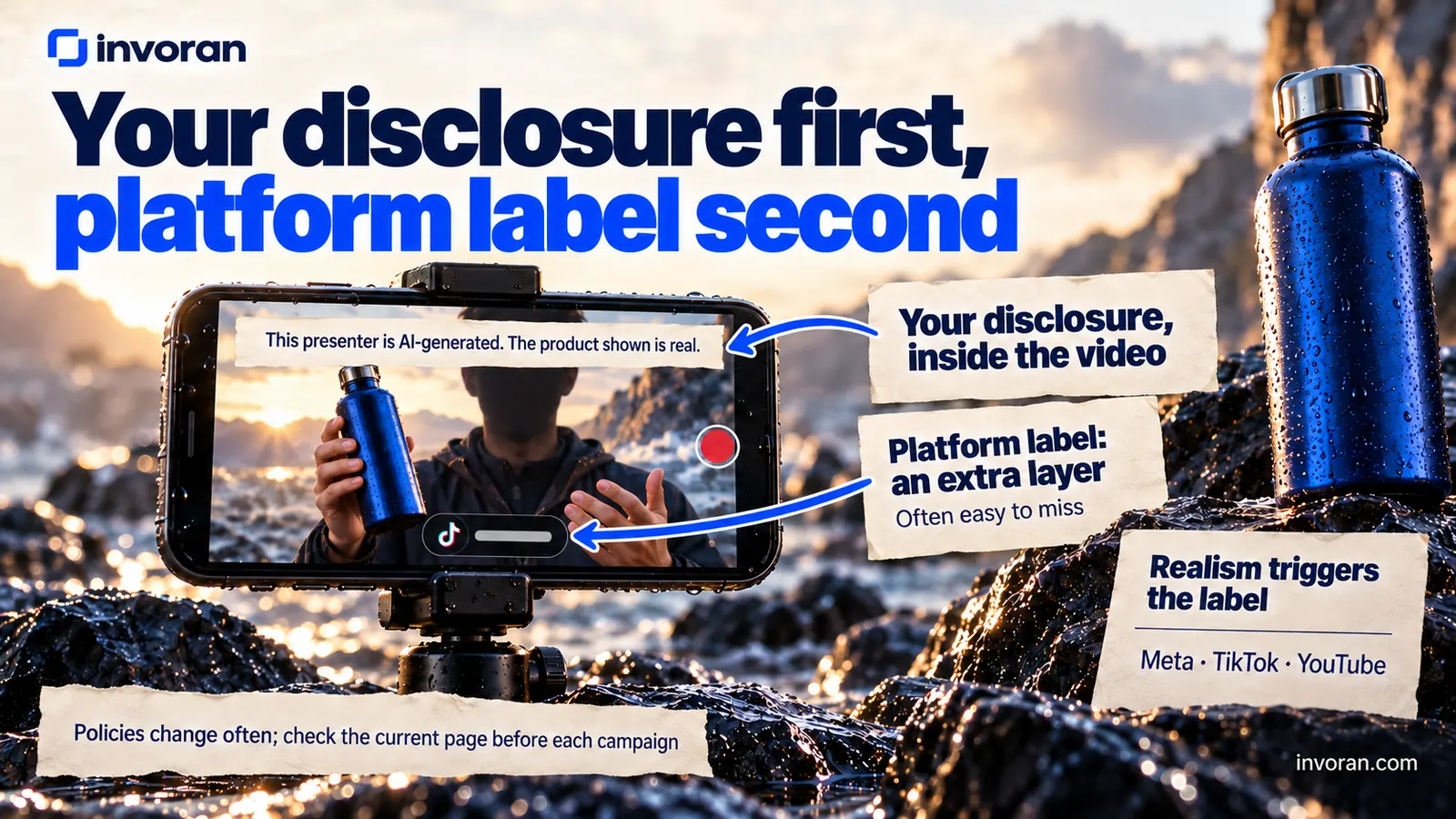
- Put the disclosure inside the video. Platform labels are often hidden in menus and don't replace your own.
What are AI UGC ads?
UGC ads borrow the look of content made by ordinary users: someone talking to a phone camera, holding the product, explaining why it matters. AI UGC ads keep the format but replace some or all of the shoot with AI tools.
AI can enter at five points: the presenter (an AI avatar), the voice (AI or a licensed clone), the scene, the product shot (a real photo animated or placed in a new scene) and the edit. The more of these you use, the less the result is "user-generated", and the more your disclosure has to carry.
AI UGC is good at hook variations, translations and getting a product video out without booking a person, a location and a day. It's not good at pretending to be a real customer. That's a legal problem, not a creative one.
Filmed, no-camera or hybrid: which AI UGC workflow fits?
Sort every idea into one of three workflows before scripting. I call it the Three-Way UGC Map: filmed, no-camera, hybrid.
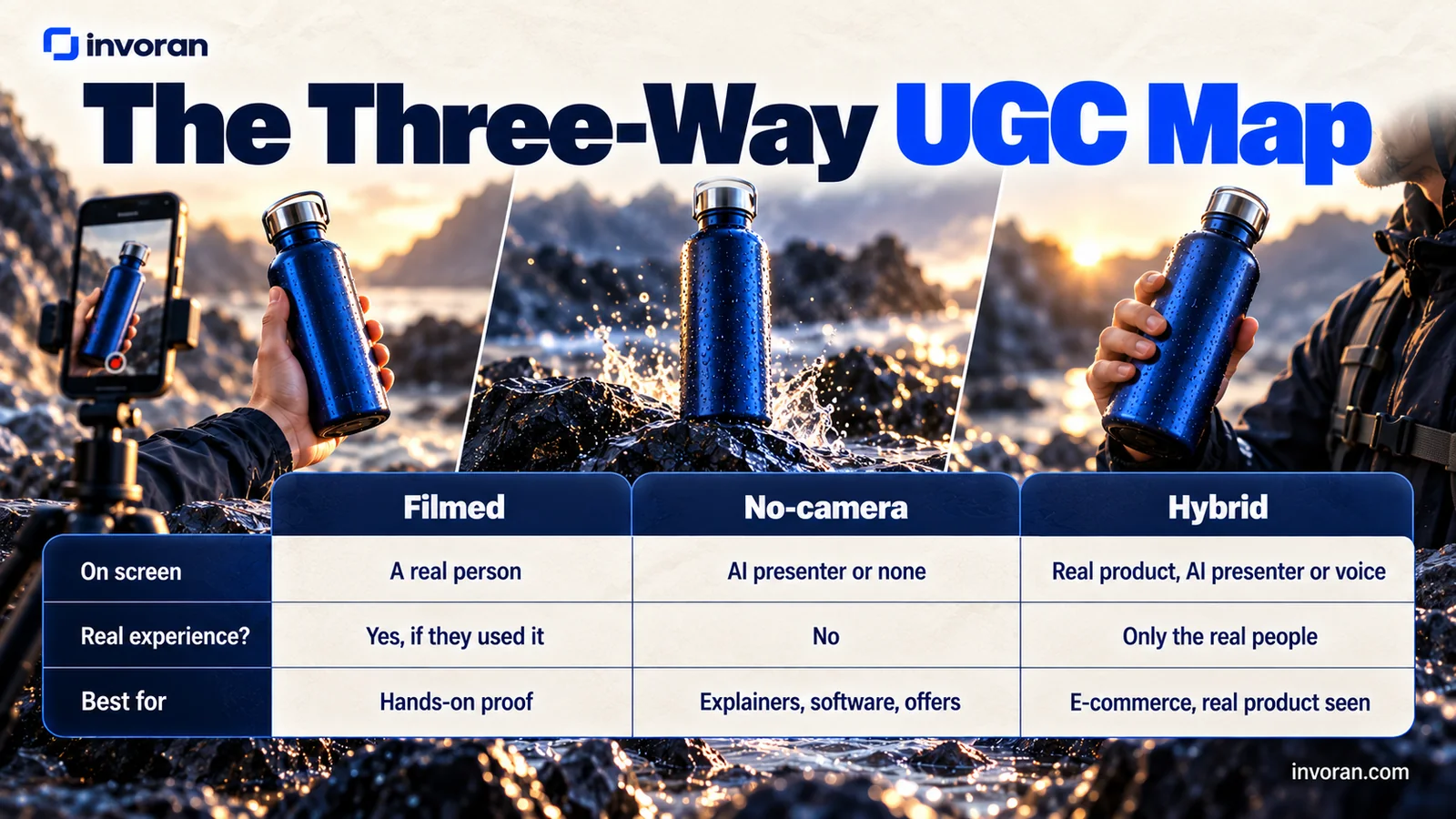
| Filmed | No-camera | Hybrid | |
|---|---|---|---|
| Who's on screen | A real person (creator, employee or customer) | An AI presenter, or no presenter at all | Real product footage, plus an AI presenter or AI voice |
| What AI does | Editing, subtitles, cut-downs, hook variations, translation | Presenter, voice, scenes, music, edit | Voice, scenes, presenter, edit |
| Can the person on screen share a real experience? | Yes, if they actually used the product | No | Only the real people in it |
| Disclosure load | Paid-relationship disclosure (for example "Ad" or "Paid partnership") | AI disclosure; plus "not an actual customer" if the presenter is framed as one | AI disclosure for the synthetic parts |
| Best for | Products that need hands-on proof: texture, fit, taste, setup | Explainers, software, offers, announcements, multilingual versions | E-commerce products where the real product must be seen but no one needs to testify |
| Main risk | Slow and costly to iterate | Looks generic; drifts into fake testimonials | Mismatch between real product shots and AI scenes |
For physical products, hybrid is usually the safest default: the product is always the real one, and AI handles the rest. My own videos are built around the brand's real product for this reason. For software and services, no-camera usually works, because the viewer needs a screen or an explanation, not a hand holding a jar.
How do you make an AI UGC ad step by step?
Seven steps, whichever workflow you use:
- Write the UGC brief. One page, before any tool is opened (template below).
- Write three hooks. The first sentence decides whether anyone hears the second.
- Script in "the product does" language. Not "I tried this and my life changed."
- Prepare real product assets. Photos, a short clip or a screen recording. AI doesn't redraw the product.
- Generate presenter, voice and scenes. I use Higgsfield for images and video, ElevenLabs for voice and Suno for music.
- Edit, subtitle and add the disclosure. I do the editing, subtitles and assembly with Claude. The disclosure goes in here, not at upload.
- Check against the real product, then publish. Color, size, packaging and every spoken claim.
The UGC brief template
- Audience: who is watching, and what they already believe.
- One message: the single thing the viewer should remember.
- Hooks: three candidate first sentences.
- Verified product facts: only what the brand has confirmed in writing.
- Claims to avoid: results, comparisons, health or income claims without a source.
- Presenter role: explainer or narrator. Never "satisfied customer" unless it's a real one.
- Disclosure line: the exact sentence that will appear on screen, for example: "This presenter is AI-generated. The product shown is real."
- Channels and approval: where it runs, and who signs off.
On hooks, my clearest data comes from a company I work with. On Pratik10's Instagram, the four most-viewed posts drew 2.1K, 2.1K, 940 and 584 views, and all four open with a question (account data, October 2026). That's one account's limited data, not a law of nature, but it's a good reason to test question hooks.
On time: count the whole job, not only the generation. Writing, waiting and corrections all add up, and a clearer brief keeps the corrections small.
How do you test which version works?
Cheap variations tempt people to change everything at once. Change one thing per round, usually the hook, and keep product, offer, audience and budget the same. Pick the metric before launch, give each version a fair run, and build on the winner. No hook is guaranteed to win.
What do AI UGC ads really cost?
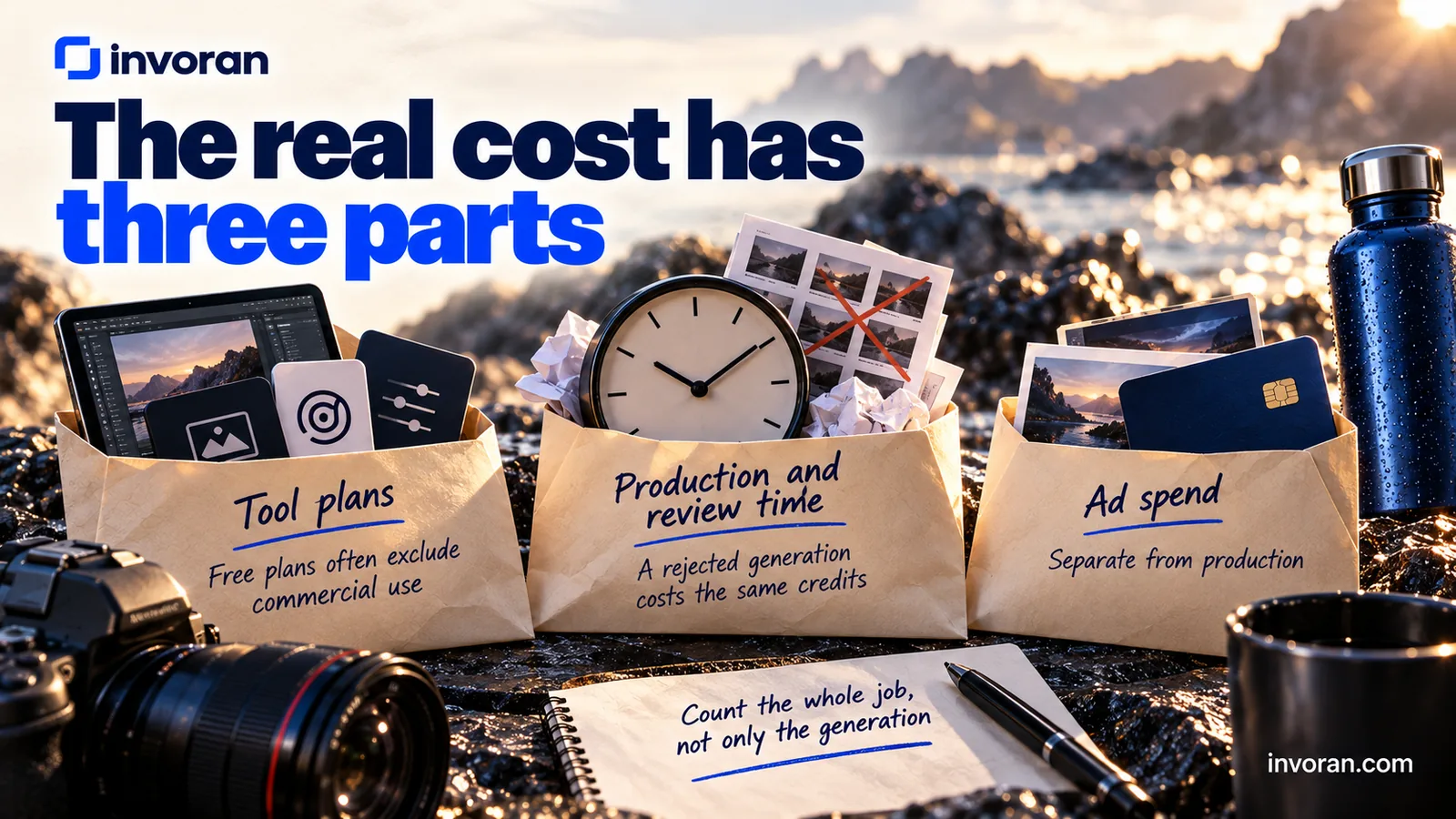
The real cost has three parts: tool plans, production and review time, and ad spend.
These are the plans I could verify on the vendors' own pages:
| Cost item | What you're paying for | Verified price (as of October 14, 2026) |
|---|---|---|
| AI voice (ElevenLabs) | Voiceover and voice cloning | Starter $6/month billed monthly, with a commercial license; Creator $22/month billed monthly (both had first-month discounts when I checked). The free plan has no commercial license |
| AI music (Suno) | Background tracks | Pro $8/month billed yearly, with commercial use rights. The free plan has no commercial rights |
| AI avatar video (HeyGen) | Talking-presenter video | Creator $29/month billed monthly. The free plan allows three videos a month, each up to 1 minute, for non-commercial use only |
| AI image and video (Higgsfield) | Scenes, product animation, presenter shots | I couldn't read a price on Higgsfield's pricing page on this date, so I'm not quoting one |
| Ad spend | Paid distribution on Meta, TikTok or YouTube | Set by you; separate from production |
| Creator fees (filmed workflow) | A real person on camera | Negotiated per creator; I don't quote market rates I haven't verified |
Two warnings. Free plans often exclude commercial use, so audio or video made on one shouldn't go into an ad. Credit-based plans also make "cost per video" hard to predict: a rejected generation costs the same credits as a good one.
To compare this with handing the job over, my packages are on my pricing page.
Do you have to disclose AI in UGC ads in the US?
I know of no single US federal rule that says "label all AI ads." But the FTC's rules on endorsements and reviews apply directly to AI UGC, and at least one state now has its own disclosure law:
- Actual consumers. Under 16 CFR 255.2(c), ads presenting endorsements by people represented as "actual consumers" should use actual consumers in both audio and video, or clearly and conspicuously disclose that they aren't. An AI presenter framed as a customer falls squarely here.
- Bona fide use. Under 16 CFR 255.1(c), an endorser represented as using the product must have been a bona fide user. An AI avatar can't be, so the script can't claim personal use.
- Fake testimonials. The Consumer Reviews and Testimonials Rule took effect on October 21, 2024. The FTC's Q&A says it has no blanket prohibition on AI avatars; it targets fake or false testimonials, including a celebrity avatar used without permission. Knowing violations can bring civil penalties.
- Paid creators. A material connection must be disclosed clearly and conspicuously, and the FTC says the brand stays responsible for what others do on its behalf. A visual and audible disclosure inside the video is the clearest.
- New York's synthetic performer law. Signed on December 11, 2025 and in effect since June 9, 2026, Senate Bill S8420A says anyone who creates a commercial ad and knows it includes a "synthetic performer" (an AI-made human performer not recognizable as a real person) must disclose that conspicuously in the ad. Fines are $1,000 for a first violation and $5,000 for later ones.
An AI presenter who explains a product isn't, by itself, a problem. One who pretends to be a customer is. Check state rules for every state where the ad runs.
What do EU AI Act Article 50 and Turkey's ad rules require?
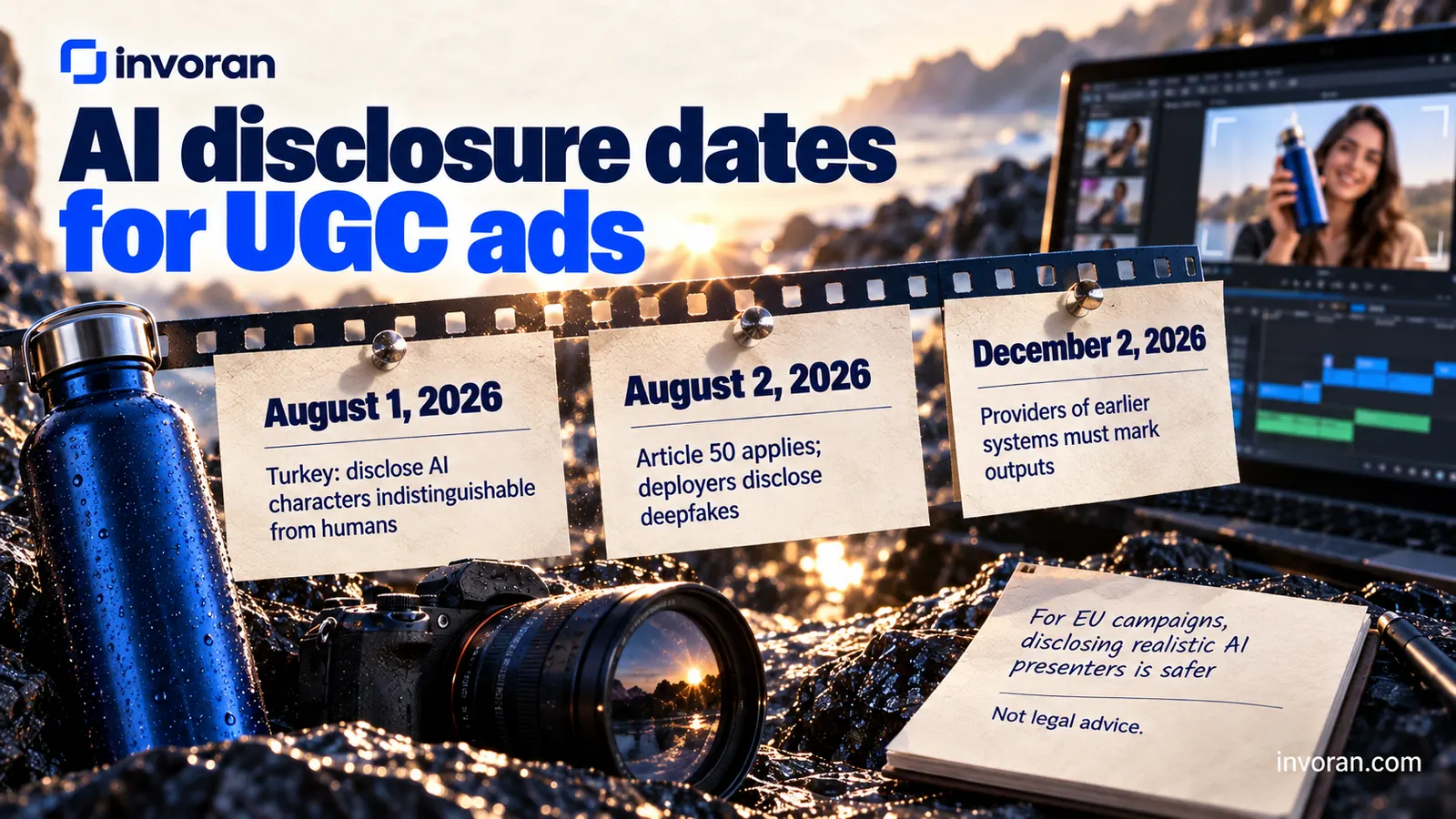
According to the European Commission, Article 50 of the EU AI Act applies from August 2, 2026.
Two duties matter for AI UGC ads:
- Deployers disclose deepfakes. If you publish AI-generated or manipulated image, audio or video that qualifies as a deepfake, you must disclose it clearly and distinguishably, at the latest at first exposure (Article 50(4)). Evidently artistic, satirical or fictional works still need an appropriate disclosure, shown so it doesn't hamper the work.
- Providers mark outputs. Providers of generative AI systems must mark synthetic output in a machine-readable way (Article 50(2)). For systems placed on the market before August 2, 2026, providers have until December 2, 2026, as the Commission's FAQ explains.
What's uncertain: whether a fully synthetic presenter who resembles no real person counts as a deepfake. The Commission's FAQ ties deepfakes to persons, places or events that exist or could plausibly exist, but doesn't address stock AI avatars. For EU campaigns, disclosing realistic AI presenters anyway is safer.
I work from Turkey, where one more rule applies. Since August 1, 2026, Turkish ads featuring AI characters indistinguishable from humans must say so clearly, and ads in which an AI copy of a real person falsely appears to use or recommend a product are banned.
How do Meta, TikTok and YouTube label AI UGC ads?
What each platform's official pages said on October 14, 2026:
| Platform | What it requires or does | Where the label shows |
|---|---|---|
| Meta (Facebook, Instagram) ads | Labels ads created or significantly edited with Meta's own generative AI tools ("AI info") and detects third-party AI tools through industry-standard signals. Check your ad account for any self-disclosure option | In the three-dot menu or next to "Sponsored"; next to "Sponsored" for photorealistic AI people. May vary by region |
| TikTok | Creators must clearly disclose AI-generated or edited content showing realistic people or scenes, for example with a caption, sticker or TikTok's own AI label where available | On the post. For non-Spark ads fully generated or significantly modified by AI, Ads Manager has a "This ad contains AI-generated content" toggle |
| YouTube | Creators must disclose realistic altered or synthetic content, such as a real person saying something they didn't | In the description; for photorealistic content, possibly in the player. For ads, Google Ads added an AI label setting in July 2026 |
Across all three, realism triggers the label, and the label is often easy to miss. So I treat platform labels as an extra layer, never the main disclosure. Policies change often; check the current page before each campaign.
What should an AI UGC ad disclosure checklist include?
Run these eight checks before an AI UGC ad goes live. They're a production habit, not a legal review:
- Realistic AI person on screen? Add an on-screen AI disclosure in the ad's language, from the moment the presenter appears.
- Anyone framed as a customer? Remove fabricated experience claims. If an actor or avatar represents a genuine testimonial, disclose the portrayal clearly and check the applicable rules.
- Anyone claiming personal use? Only real people who used the product may say so.
- A cloned voice? Only with the owner's written permission, saying only true things.
- Real product? Color, size, packaging and results match what the customer receives.
- A paid creator? Disclose the relationship in the video and caption with clear words such as "Ad."
- Platform labels set? TikTok's AI label or Ads Manager toggle, YouTube's disclosure or Google Ads label and, where it applies, Meta's.
- Production record kept? Tools, plans, source assets, permissions, approved script and approval date.
Where do AI UGC ads fall short?
AI UGC is a production method, not a shortcut to trust. The most common limits:
- Hands and products. AI presenters still struggle to hold or apply a real product convincingly, which is why hybrid keeps real footage.
- Sameness. Stock avatars and default voices are recognizable.
- Testimony. The strongest UGC is a real person's real experience. AI can't supply that.
If you're deciding whether to hand this to someone, my guide on how to choose an AI video agency lists the questions I'd ask, with my own answers. My AI content and video service page shows what I take on.
Frequently asked questions
Are AI UGC ads legal?
Yes, AI UGC ads are generally legal, as long as they don't mislead. In the US, an AI presenter can't be framed as an actual customer without disclosure and can't claim personal use. The EU requires deepfake disclosure, and Turkey requires disclosing realistic AI characters in ads. Check the rules for every market where the ad runs.
Do I have to label AI UGC ads?
Often, yes. TikTok and YouTube require labels on realistic AI content, and Meta labels ads made with detectable AI tools. New York and Turkey require disclosure of realistic AI performers in ads, and EU deepfake disclosure applies from August 2, 2026. Even where no rule applies, an on-screen line is the safest choice.
Can an AI avatar give a testimonial?
No, not as a real testimonial. Under the FTC's Endorsement Guides, an endorser who claims to use a product must have been a bona fide user, and an AI avatar can't be one. An avatar can explain what the product does. It shouldn't describe experiences, results or feelings as its own.
How much do AI UGC ads cost to make?
The cost depends on tool plans, production time and ad spend. As of October 14, 2026, ElevenLabs Starter is $6 a month billed monthly, Suno Pro is $8 a month billed yearly and HeyGen Creator is $29 a month billed monthly. Free plans usually exclude commercial use. Creator fees and ad spend are separate.
Are AI UGC ads better than real creator content?
Neither is better across the board; they do different jobs. Real creators bring genuine experience and hands-on proof, which AI can't provide. AI UGC is faster for producing variations, translations and explainers. I often suggest both: real creators for testimony, AI workflows for volume and testing.
Conclusion: Make the product real and the disclosure obvious
AI UGC ads let you skip the shoot day, but not the rules. Pick the workflow by what your product must prove, brief before you prompt, let AI presenters explain rather than testify, and keep the disclosure inside the video.
If you'd rather not run the tools yourself, my monthly service is $750 + VAT a month (October 2026): twelve videos with your real product, plus a website, email outreach, a content plan and publishing across six channels, so it's not a per-video price. Ad spend and tools are separate, and I don't guarantee reach or sales. Message me on WhatsApp; the first 15 minutes are free.
Sources
- eCFR — 16 CFR Part 255 (FTC Endorsement Guides)
- FTC — Endorsement Guides Q&A
- FTC — Consumer Reviews and Testimonials Rule Q&A
- New York State Senate — Bill S8420A (signed December 11, 2025)
- Google Ads Help — Updates to AI labeling requirements (July 9, 2026)
- European Commission — Article 50 AI Act transparency FAQ (updated July 24, 2026)
- Meta Newsroom — Gen AI transparency in ads (updated June 1, 2026) and Meta Business Help
- TikTok — Community Guidelines: Integrity and Authenticity
- TikTok Ads Help — Add disclaimers to ads (September 2025)
- YouTube Help — Disclosing altered or synthetic content
- Resmî Gazete (Turkey) — Commercial Advertising Regulation amendment (in force August 1, 2026)
- Vendor pages, checked October 14, 2026: ElevenLabs, Suno, HeyGen, HeyGen terms, Higgsfield.
- Pratik10 Instagram account data (October 2026, internal).