Last updated: October 14, 2026
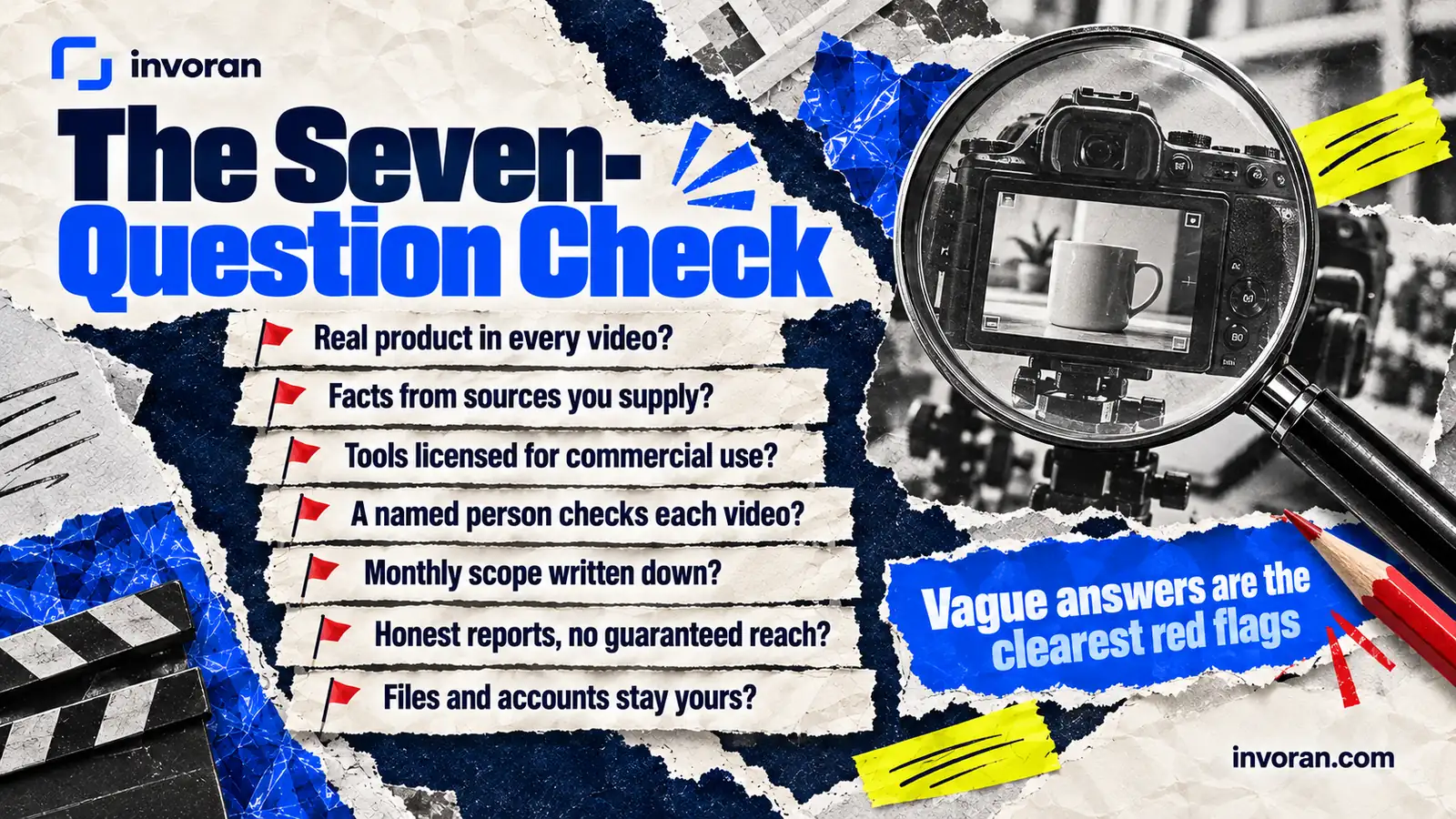
An AI video agency makes marketing videos with AI tools for visuals, voice, music and editing instead of a traditional film shoot. To choose one, ask every agency on your shortlist the same seven questions before you sign. Will the videos show your real product? Who writes the scripts, and where do the facts come from? Are the tools licensed for commercial use? Who checks every video before it goes live? What exactly is in the monthly scope, in writing? What will be reported, and what is promised? What happens to your files and accounts if you stop? A good agency answers each one plainly and puts the answers into the written scope. Vague answers about results, rights or ownership are the clearest red flags. Below, each question comes with my own answer as a benchmark.
In short:
- Real product, real facts. The videos should show what you actually sell, and the script should come from facts you supplied.
- Rights before reach. Ask which plans the tools run on and how the agency handles AI labels on each platform.
- Scope in writing. Number of videos, channels, revisions, files and account access, agreed before work starts.
What does an AI video agency do?
An AI video agency plans, scripts, produces, edits and often publishes short videos, using generative AI in place of most of a traditional shoot. The work usually includes a script written from your product information, AI-generated or AI-edited visuals, a voiceover, music, subtitles and a final cut sized for each platform. Some stop at delivery; others also publish and report.
Two other labels overlap with it. An AI ad agency usually focuses on paid campaigns: media buying, ad creative and testing. An AI content agency or AI content marketing agency covers a wider mix of posts, articles, visuals and video. An AI video agency sits in the middle: video first, often for both organic channels and ads.
Quotes rarely say which kind of production you are buying, so ask: fully synthetic (scenes, motion and voice from AI tools, built around your product photos), hybrid (your own footage extended with AI scenes and voice) or AI-assisted editing of a conventional shoot.
AI changes the production cost of each video, not the thinking behind it. A fully synthetic workflow can avoid a shoot day and a reshoot when a line changes; filmed or hybrid work can still need both. What decides whether a video works stays the same: a clear idea, accurate product facts, a strong opening line and someone who checks the result.
In my own work, Higgsfield handles AI images and video, Google Flow and Nano Banana help with still frames, ElevenLabs produces voice and Suno produces music. I do the editing, subtitles and assembly with Claude (more in my guide to Claude AI for marketing). Any agency should be able to name its tools this plainly.
Which seven questions should you ask an AI video agency?
I call this the Seven-Question Check. Write down each agency's answers and compare them side by side. The table shows what a good answer sounds like and what should make you walk away.
| Question | Good answer | Red flag |
|---|---|---|
| Will the videos show our real product? | "Yes. Every video is built around your actual product and the assets you approve." | Generic stock scenes, or a product that looks different from the one customers receive |
| Who writes the script, and where do the facts come from? | "I write it from facts you supply, and I don't add features or results you haven't given me." | "AI writes the scripts" with no mention of a fact source or review |
| Are the tools licensed for commercial use? | Names each tool and confirms the plan allows commercial use | Plans that do not permit the intended commercial use, unnamed tools, or undocumented rights |
| Who checks every video before it goes live? | A named person reviews every output, and you approve before publishing | Fully automated output published without your approval |
| What exactly is in the monthly scope? | Video count, channels, revisions, files and access, written down before work starts | "Unlimited" videos, or a scope that only exists in a sales call |
| What do you report, and what do you promise? | Actual views and website visits, kept separate; no guaranteed reach | Guaranteed views, followers or sales, or totals that mix different measures |
| What happens if we stop? | No lock-in; files and access defined in writing; a clean handover | Long minimum terms, or files and accounts held by the agency |
How do I answer the seven questions myself?
Here is how I answer each question for my AI video production service.
Will the videos show our real product?
Yes. Every video I produce features your actual product and follows your brand's voice. You send accurate product information and the assets you want used, and I build the visuals around them. AI handles the scene, motion, voice and edit; it doesn't invent a product that looks better than the one in the box.
Who writes the script, and where do the facts come from?
I write every script myself, using AI for drafts, and every fact in it comes from you. I don't add features, results or claims you haven't provided. This matters more than any tool choice, because AI models state wrong information with total confidence. If an agency's answer is "the model knows your industry," keep looking.
Are the tools licensed for commercial use?
As of October 14, 2026, ElevenLabs' free plan doesn't include a commercial license (it starts with the Starter plan), and Suno's free plan says "No commercial rights." Audio from those free plans doesn't belong in an ad. Before we start, we agree in writing which of the tools I named above are used for your videos and how their subscriptions are handled; tool subscriptions are not included in my monthly price. Whoever you hire, ask for a record of which tool and which plan produced each asset.
Who checks every video before it goes live?
I do. I'm one person, I handle every project myself, and I check every AI output by hand before it reaches your channels. You approve the publishing plan before anything goes live. That is also why I work with a maximum of five brands at a time. Time is lost less in generation than in waiting on tools and fixing mistakes, so a realistic schedule counts the corrections too. An agency that says videos come out finished in seconds isn't counting the check.
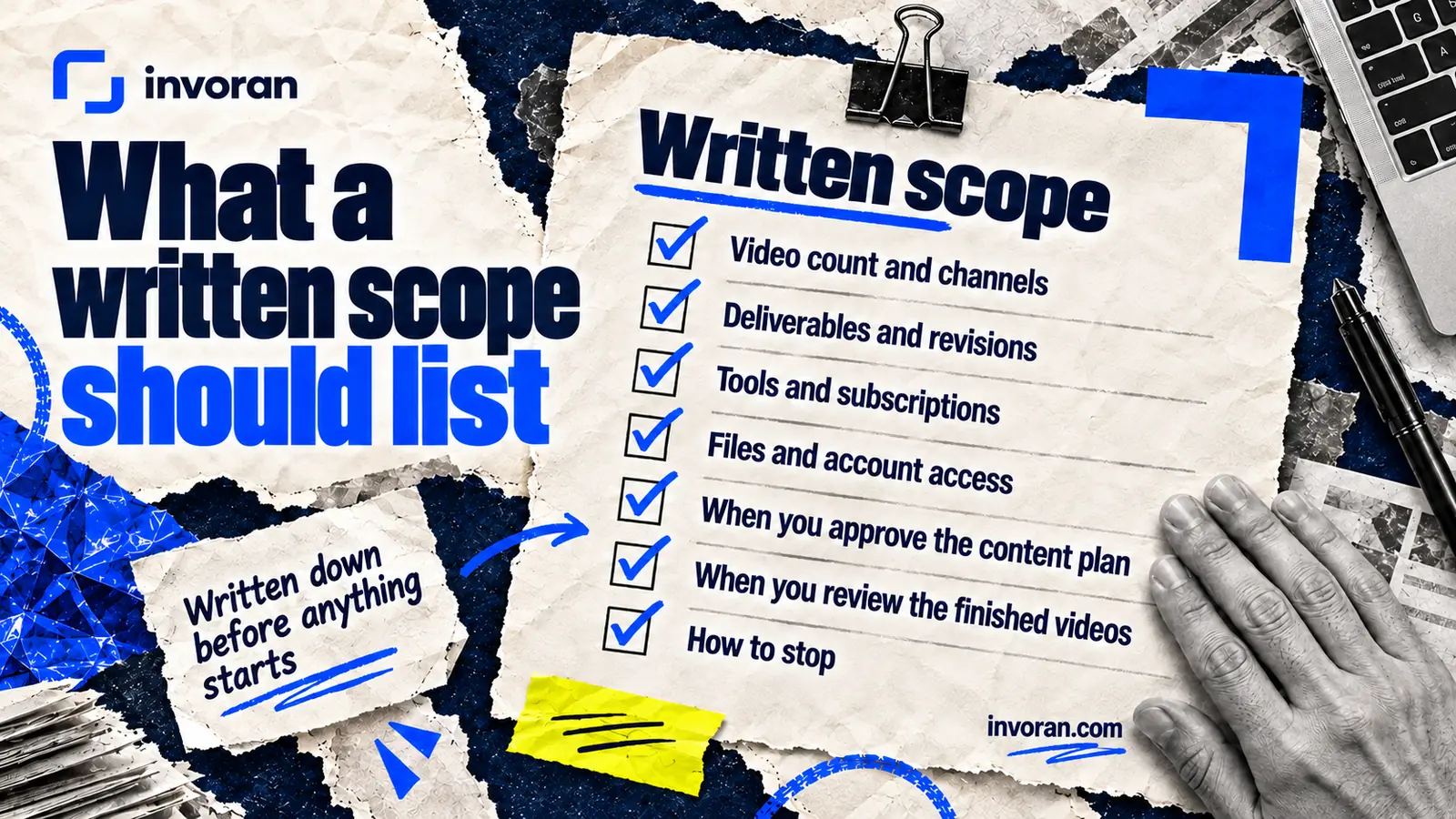
What exactly is in the monthly scope?
The monthly service covers 12 AI videos a month featuring your product, adapted for six channels (Instagram, YouTube, LinkedIn, TikTok, X and Facebook), which makes 72 posts. It also includes a custom-coded website, 300–500 personalized emails a month and a one-page monthly content plan. The "Published every day" package is the same service with 30 videos a month, or 180 posts; the only difference is the number of videos. Deliverables, revisions, files and account access are written down before anything starts, including when you approve the content plan and when you review the finished videos.
What do you report, and what do you promise?
Each month I report actual views and website visits, and keep posts, views and visits separate, because one person can see several posts. I don't promise reach or sales; I promise consistent production and an honest report on what to change next. For example, at Pratik10, one of the companies I work with, the four most-viewed Instagram posts drew 2.1K, 2.1K, 940 and 584 views, and all four open with a question (Pratik10 account data, October 2026). That suggests a hook to test next; it doesn't prove why those posts did better, and it says nothing about sales.
What happens if we stop?
You can stop the monthly service in any month; there is no minimum term. Files and account access are defined in writing before we begin, and when the service ends, all website source files are handed over to you in full. With any agency, ask who owns the channel accounts, the ad accounts and the finished videos. Your accounts should stay under your control, and finished-file delivery, project files, usage licenses and any copyright transfer should each be written down separately.
How much does an AI video agency cost?
AI video agencies usually price in one of three ways: per video, per project, or as a monthly retainer for a set number of videos. Compare what each quote includes, not the headline number: a low per-video price can exclude scripting, revisions or publishing.
Five items decide what you actually pay:
- Video count and length. How many finished videos a month, and how long each is.
- What's inside each video. Script, voice, music, subtitles and platform versions, or only the edit.
- Publishing and reporting. Whether the agency posts and reports, or only hands over files.
- Separate costs. Ad spend, tool subscriptions, licenses and stock assets.
- Revisions and terms. Rounds of changes, and any minimum contract.
As a benchmark, my own packages are public on my pricing page (October 2026): $750 + VAT a month for 12 videos plus the rest of the monthly service, $1,350 + VAT a month for 30 videos, and $100 + VAT an hour for work outside the packages, with ad spend and tool subscriptions paid separately.
What rules apply to AI video ads in 2026?
A good AI video agency builds these rules into its process.
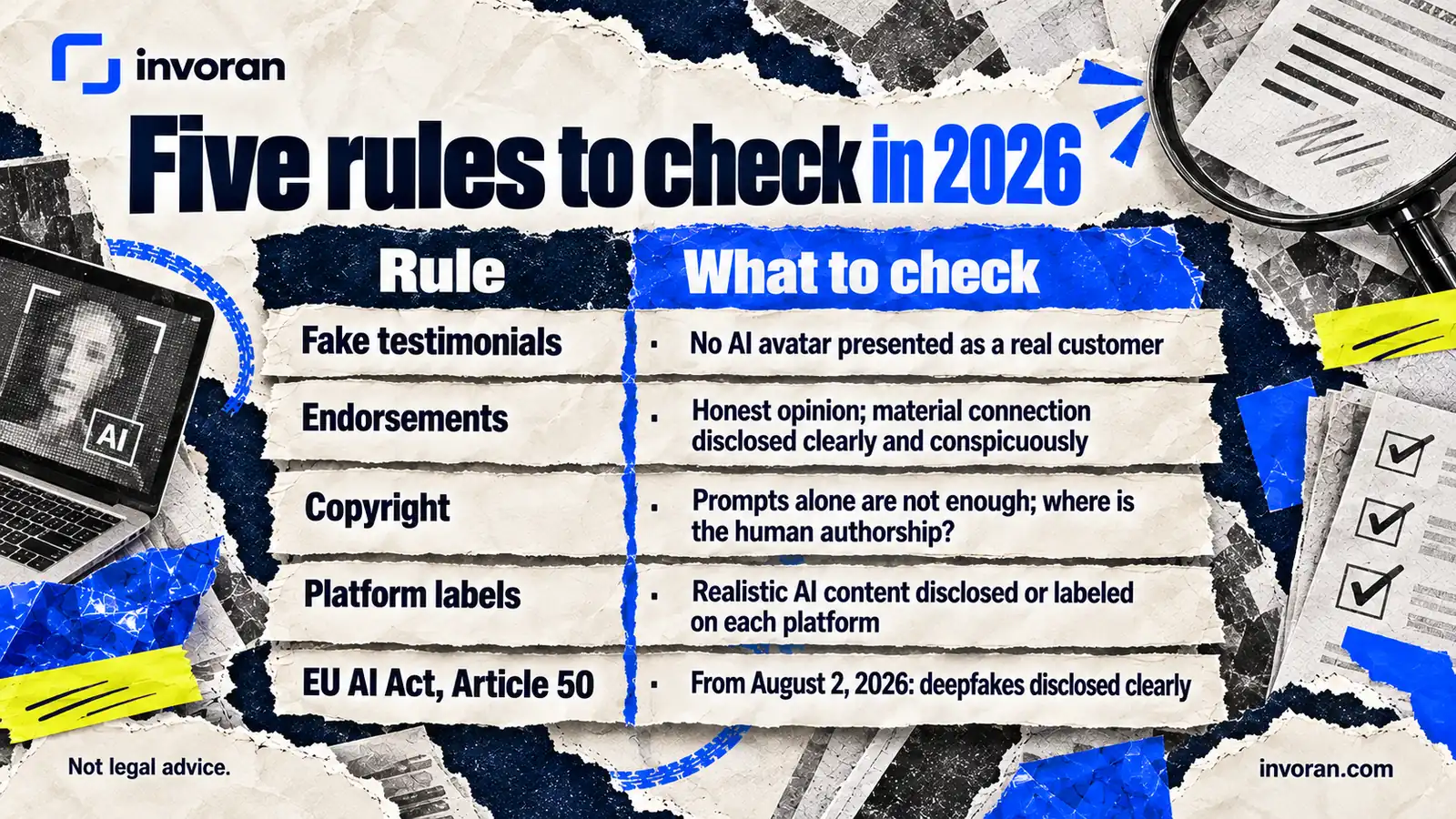
Check these five:
- Fake testimonials. The FTC's rule on consumer reviews and testimonials, announced in August 2024, covers testimonials that misrepresent that they come from someone who doesn't exist, including AI-generated fake reviews. An AI avatar presented as a real customer who "loved the product" is exactly the risk. If you're planning AI UGC ads, make sure the format doesn't pretend to be a real customer review.
- Endorsements. The FTC's Endorsement Guides say an endorsement must reflect the endorser's honest opinion, and a material connection, such as payment, should be disclosed clearly and conspicuously.
- Copyright. The U.S. Copyright Office concluded in January 2025 that AI outputs are protectable only where a human author has determined sufficient expressive elements, and that prompts alone are not enough. Ask where the human authorship sits in your videos: script, arrangement or editing.
- Platform labels. YouTube requires creators to disclose when they use AI to meaningfully alter or generate photorealistic content. Meta requires people to use its disclosure tool for organic posts with photorealistic video or realistic-sounding audio that was digitally created or altered, and it labels AI-generated content on Facebook, Instagram and Threads. TikTok requires labels on AI content that shows realistic-appearing scenes or people.
- European Union. Article 50 of the EU AI Act applies from August 2, 2026. Deployers must disclose deepfakes clearly, at the latest at a viewer's first exposure. If your videos reach EU audiences, plan the label from the start.
If a campaign sits close to the line, ask a lawyer before it runs.
How do you test an AI video agency before signing?
Give each agency the same short brief and compare what comes back.
- Send one real product. Include the facts, one or two photos, the audience and one claim you never want made.
- Ask for a script first. Read it before any video is made.
- Ask how the video would be checked. Who reviews it, against what, and when you approve it.
- Ask for the scope in writing. Count, channels, revisions, files, access, separate costs and how to stop.
- Look at published work. Real videos on real accounts, with a source and a reporting period for every number they quote.
When the script and a sample video come back, judge four things before polish:
- The opening line. Does it give a viewer a reason to stay?
- The product. Does it look like the one in the box?
- The facts. Does every claim trace back to your brief?
- The label. If it shows realistic AI people or scenes, how will it be labeled on each platform?
You can see how I present my own projects, with a source and a period for every number I quote, on my work page. If an agency only shows a showreel, ask where those videos ran.
Agency, freelancer, AI tool or your own team: which should you choose?
An agency is one of four ways to get AI video made. The right one depends less on budget than on who owns the work each month.
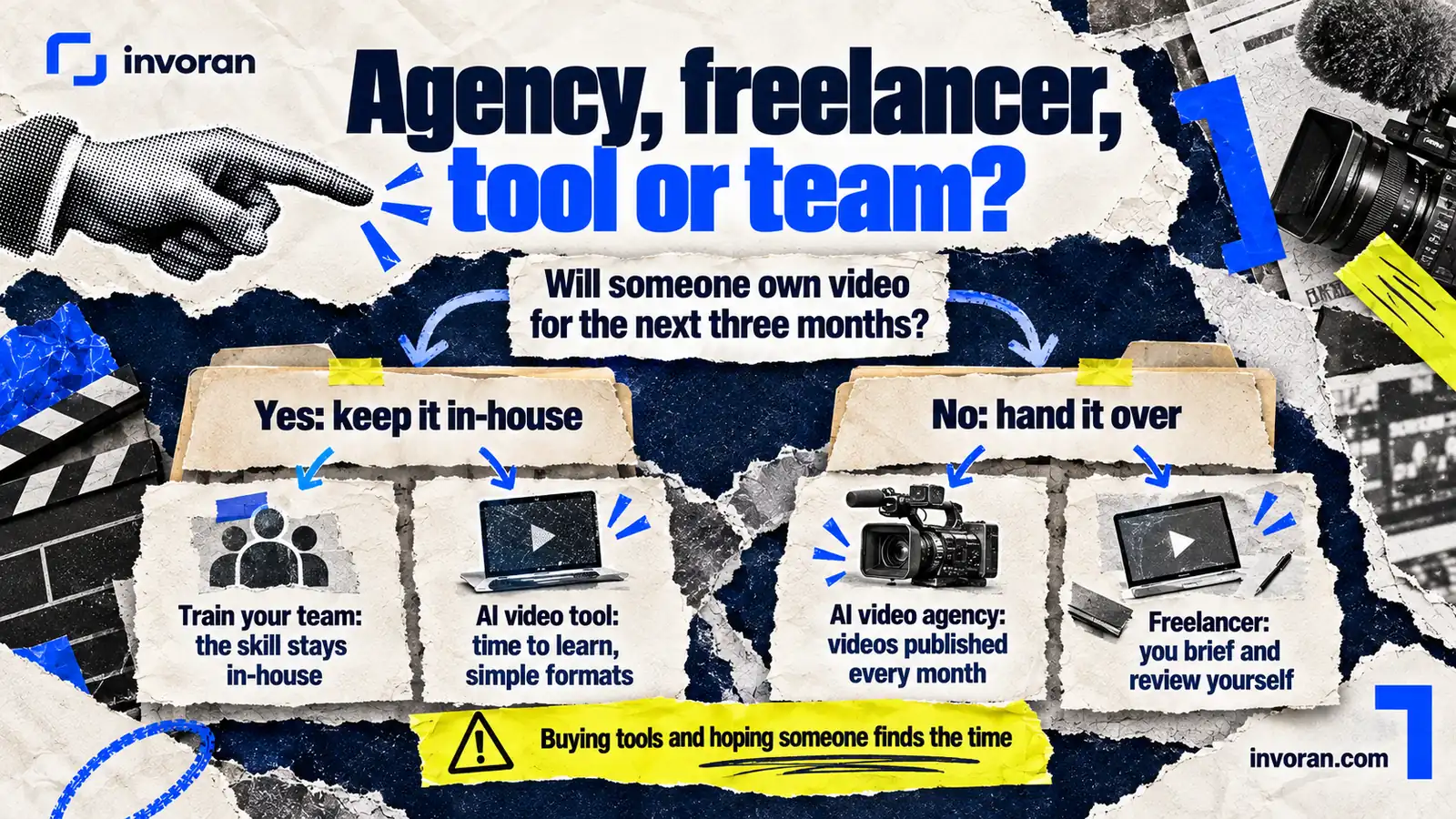
| Option | Fits when | Watch for |
|---|---|---|
| AI video agency | You want videos published every month without building the skill in-house | Scope, rights and exit terms that exist only in a sales call |
| Freelancer | You need a set number of videos and can brief and review them yourself | One person's availability; files and rights never written down |
| An AI video tool your team runs | Someone has time to learn it and you need simple formats | The plan's commercial terms and the hours spent checking |
| Training your team | Someone will own video for months and the skill should stay in-house | Training with no named person to use it afterward |
A simple way to decide: if no one on your team will own video production for the next three months, hand it over. If someone will, hands-on AI training for your team is worth a look, because that person learns to brief, generate and check on your own products. The wrong choice is buying tools and hoping someone finds the time. For outside help beyond video, see AI marketing consultant vs. agency vs. course; for the bigger picture, my guide on how to use AI in marketing maps the main jobs and tools.
Frequently asked questions
Do AI-generated videos need to be labeled?
Often, yes. YouTube, Meta and TikTok all require disclosure of realistic AI-generated or AI-altered content, and in the European Union, Article 50 of the AI Act requires clear disclosure of deepfakes from August 2, 2026. Labeling rules differ by platform and content type, so check each channel before publishing.
Who owns videos made with AI?
Ownership depends on your contract and on how much human authorship the video contains. The U.S. Copyright Office has said prompts alone don't make an AI output protectable, while human-written scripts, arrangement and editing can be. Put ownership of finished files and accounts in writing before production starts.
Can an AI video agency guarantee views or sales?
No honest agency can guarantee views or sales, because platforms decide distribution and buyers decide purchases. What an agency can commit to is the scope: how many videos, on which channels, by when, and what gets reported. Treat any guaranteed number as a red flag, not a selling point.
Is an AI video agency cheaper than traditional video production?
It can cost less per video when a fully synthetic workflow avoids a shoot day, crew or studio, but the comparison depends on scope. Some quotes exclude scripting, revisions, publishing or tool subscriptions. Compare what each video includes and what you pay separately, not only the headline monthly or per-video price.
What should I prepare before contacting an AI video agency?
Prepare accurate product facts, a few real product photos or clips, your audience, the channels you want to publish on, and any claims you must never make. Add examples of videos you like and why. A clear brief shortens the first conversation and makes quotes from different agencies easy to compare.
The bottom line: ask for the answers in writing
The tools matter less than the answers. Put the same seven questions to every agency on your shortlist, and sign only when the answers are in the written scope.
If you'd like to put the seven questions to me directly, send me a message on WhatsApp. The first 15 minutes are free.
Sources
- Federal Trade Commission — Final rule banning fake reviews and testimonials (August 2024)
- Federal Trade Commission — FTC's Endorsement Guides: What People Are Asking
- U.S. Copyright Office — Copyright and Artificial Intelligence, Part 2: Copyrightability (January 29, 2025)
- European Commission — Transparency obligations under Article 50 of the AI Act (FAQ)
- YouTube Help — Disclosing altered or synthetic content
- Meta — Labeling AI-generated images on Facebook, Instagram and Threads
- TikTok — Supporting responsible, transparent AI-generated content
- ElevenLabs pricing and Suno pricing, checked October 14, 2026.
- Pratik10 Instagram account data, October 2026 (internal).