Last updated: October 14, 2026
An AI marketing consultant helps you decide where AI fits in your marketing (which jobs to change, which tools to use, who checks the output) while your own team does the work. Hire an AI agency when you want the work produced for you every month. Choose a course or hands-on training when your people have time to learn and the skill should stay inside the company. The fastest way to decide is to ask four questions about each option: who does the work, what it costs, how soon you see a first result, and what you keep when it ends. Often, the right answer is two of the three, one after the other. I offer all three, so below I use my own published prices rather than vague ranges.
In short:
- Consultant: you get decisions and a plan; your team still produces the work.
- Agency: you get finished output every month; the skill stays with the agency.
- Course or training: your people get the skill; output depends on whether they use it.
- Decide by who will do the work next month, not by which option sounds most advanced.
What does an AI marketing consultant do?
An AI marketing consultant helps a company decide how to use AI in its marketing: which jobs to hand to AI, which tools to use, how to brief them, who checks the output and how to measure the result. The deliverable is usually advice, a written plan, workflow designs and sometimes prompt templates, not a monthly stream of content.
Typical work includes:
- A review of current marketing. Which jobs repeat every week, who does them and how long they take.
- Tool choices. Which assistants, image, video and automation tools fit, and which plans allow commercial use.
- Workflow design. Brief templates, review steps and approval rules, so AI drafts and people decide.
- Measurement. What to track before and after, so the team can tell whether a change helped.
- Hand-off. Explaining the plan to the people who will run it.
So what is AI consulting, and where does marketing fit? The term often means software work: building models, data pipelines or custom applications. An AI marketing consultant works one level up, on campaigns, content, channels and the people who produce them. A custom chatbot integrated into your systems needs a different specialist; changing how your team writes, designs, publishes and reports is marketing consulting.
You will also see the term boutique AI consulting firms: independent specialists or compact teams who work closely with a limited number of clients.
How does an AI marketing consultant compare with an agency or a course?
I call this comparison the Four-Column Test: put the three options in rows and answer the same four questions for each. The cost column shows the usual pricing model and my own published price, as listed in October 2026.

| Option | Who does the work | What it costs | Time to a first result | What you keep |
|---|---|---|---|---|
| AI marketing consultant | Your team. The consultant decides with you and reviews. | Usually hourly or per project. With me (October 2026): $100 + VAT an hour. | A plan comes quickly; results wait until someone on your team carries it out. | A plan, decisions and templates. The production skill stays with whoever executes. |
| AI agency | The agency produces; you supply facts and approve. | Usually a monthly retainer. With me (October 2026): $750 + VAT a month, or $1,350 + VAT a month for the "Published every day" package. | Output starts on the delivery schedule in the written scope, without waiting for your team to learn the skill or find the time. | Finished output, plus the files and access defined in writing. With me, all website source files when the service ends. |
| AI course or training | Your people, after they learn. | Free online courses, paid courses per seat, or team training per group. With me (October 2026): $750 + VAT one-time for 8 hours, one to four people, payable in three installments. | Self-paced courses depend on whether people apply them. In my training, the team leaves with drafts built on its own material. | Skills inside your company, and a workflow your team can rerun. |
Three things stand out when you read the table across.
First, an agency usually takes recurring production off your team. A consultant may also execute work if that's in the scope, but consulting and courses usually assume someone inside will produce. If no one has the time, a plan or a course won't change much.
Second, training is the option built to keep the skill inside the company. Consulting and agency work can also transfer skills when handover and practice are included; otherwise the know-how stays with the agency, and a plan is only as good as the people who carry it out.
Third, costs aren't directly comparable. An hourly rate buys decisions, a retainer buys output, and a training fee buys capability. Compare each option with what you'd spend doing nothing differently, not with each other.
When do you need an AI marketing consultant?
A consultant is the right first step when the problem is deciding, not producing.
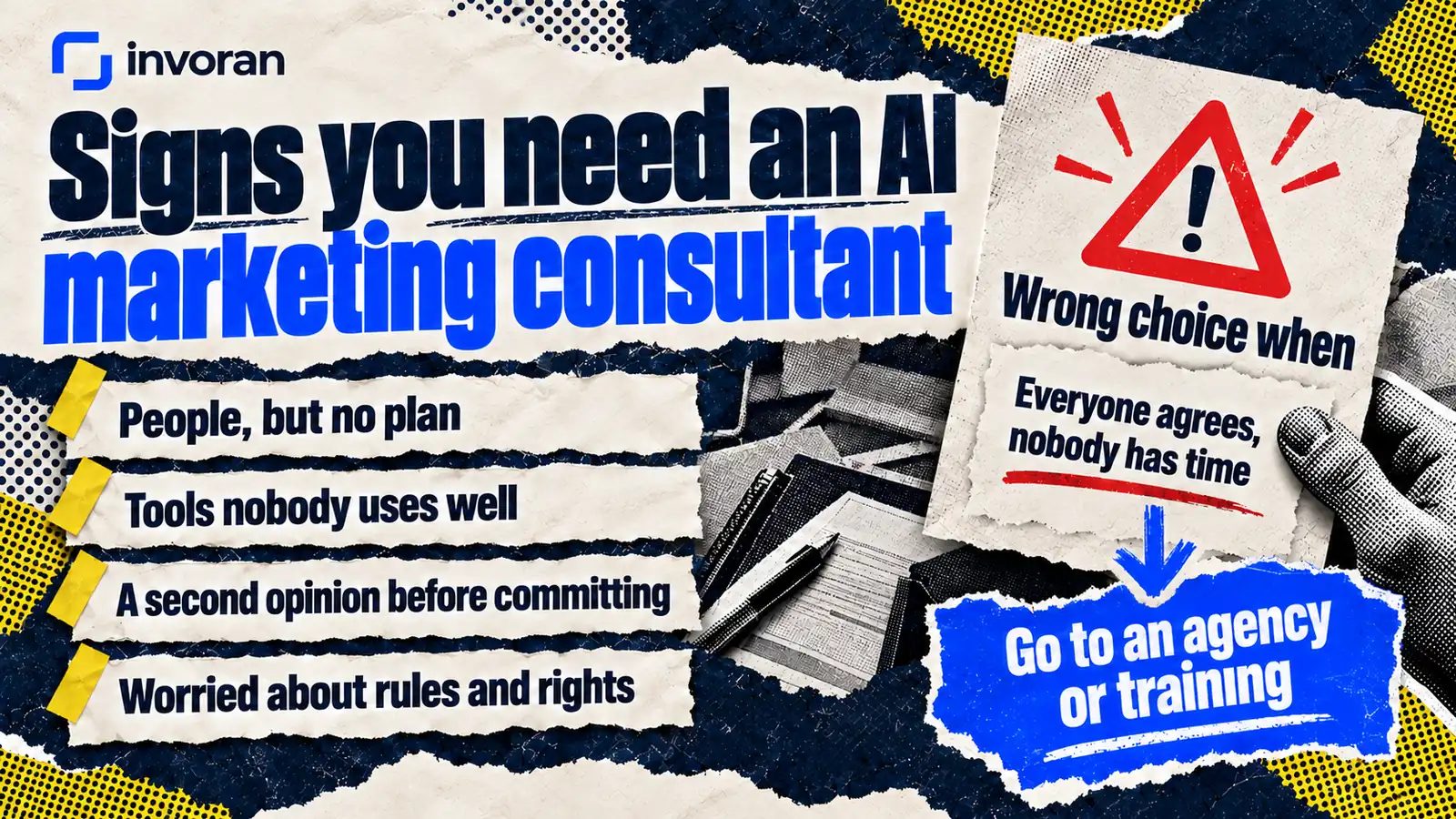
These are the usual signals:
- You have people, but no plan. Your team could produce more with AI, but nobody has decided which jobs to change first.
- You're paying for tools nobody uses well. Subscriptions have piled up without a clear job attached to each one.
- You need a second opinion before committing. You're about to sign with an agency or roll out a tool and want the plan checked.
- Rules and rights worry you. Which AI content needs labels, and where customer data should never go.
A consultant is the wrong choice when everyone agrees on what needs to happen and simply lacks the time. Advice won't publish a single video; go to an agency, or to training if you can free up someone's hours.
When is an AI marketing agency the better choice?
An AI marketing agency is the better choice when you want consistent output every month and you'd rather not build the skill in-house. You supply product facts and approval; the agency plans, produces, publishes and reports.
Choose an agency when:
- Output has to be steady. Videos, posts and emails go out every month, whatever else is happening.
- No one inside owns production. Marketing is one of several jobs for the people you have.
- You want one process behind several channels, so the website, videos and outreach tell the same story.
Before you sign, check whether the videos feature your real product, who writes the scripts and from what facts, who reviews every output, what the written scope and reports promise, and what happens to files and accounts if you stop. I cover those questions in my guide on how to choose an AI video agency.
My AI marketing services work this way. The monthly service includes a custom website, twelve AI videos a month published across six channels, between three hundred and five hundred personalized emails a month, and a one-page content plan every month. Ad spend, tool subscriptions, domain and hosting are separate. You can stop in any month, I work with a maximum of five brands at a time, and I don't guarantee reach or sales.
When is an AI course or training enough?
A course or training is enough when your people have time to apply what they learn and you want the capability to stay in the company. A self-paced course can have a low entry cost, and hands-on training can produce a first draft during the session itself; either way, results depend on whether anyone uses the skill the following week.
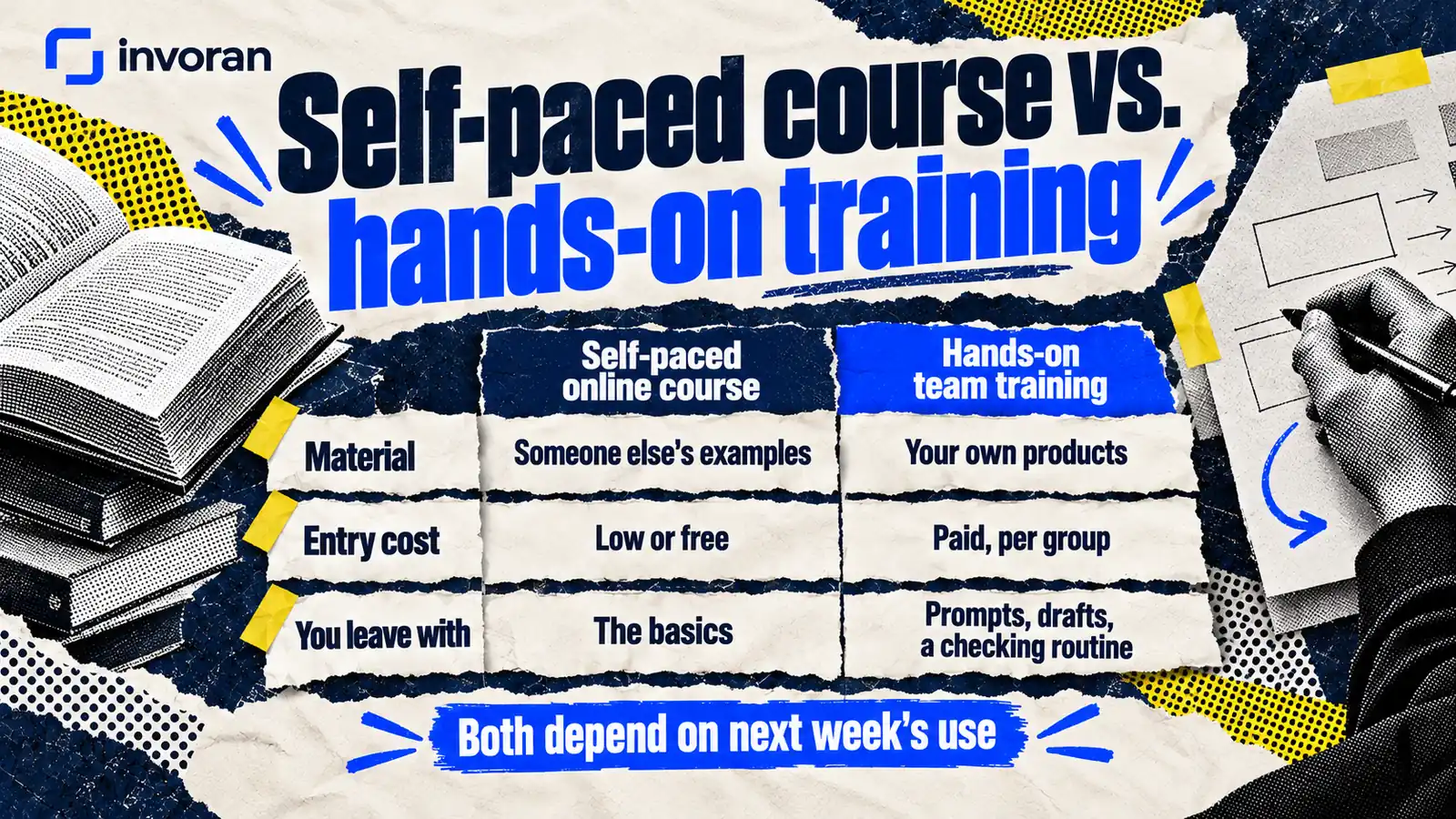
Self-paced online courses are a good, low-cost way to learn AI for marketing. In March 2025, OpenAI described its OpenAI Academy as a publicly available, free online resource hub, and Anthropic Academy offers courses on topics such as AI fluency and Claude Code. If one motivated person wants the basics, start there before paying anyone. The limit: a general AI for marketing course teaches on someone else's examples, so applying it to your products is left to you.
Hands-on team training works on your own material from the first hour. My AI training for employees runs online and is 8 hours in total for one to four people, either as an intensive two-day format or as sessions spread over several weeks. Every exercise comes from your business: your products, customer questions and brand voice. Exercises use tools such as ChatGPT, Claude and Higgsfield, with the emphasis on judging and improving output, not only generating it. By the end, your team has prompts, drafts and a checking routine built on its own work.
What does the EU AI Act say about AI literacy training?
In the European Union, Article 4 of the EU AI Act, on AI literacy, has applied since February 2, 2025. It asks providers and deployers of AI systems to take measures to support the AI literacy of their staff. The Digital Omnibus amended the article in July 2026; according to the European Commission, ensuring AI literacy remains an obligation for providers and deployers, with no specific level mandated. The Commission's FAQ states that there is no need for a certificate; organizations can keep an internal record of trainings and other initiatives instead.
How much does an AI marketing consultant cost?
AI consulting rates vary widely, and published averages mix very different work, from software projects to marketing advice, so I don't quote a market average here. Instead of comparing rates in the abstract, compare what each quote buys, and put every quote in the same unit: the price of a written plan, and the price of each month of help after it.
Ask every consultant four things:
- How is the work priced? Hourly, per project or as a monthly retainer.
- What is the deliverable? A call, a written plan, workflow templates, or ongoing reviews.
- What is excluded? Tool subscriptions, ad spend and any production work.
- What happens after the plan? Do they help your team carry it out, or hand over a document and leave?
If you're weighing a hire instead, use a real benchmark. The US Bureau of Labor Statistics puts the median annual wage for market research analysts and marketing specialists at $78,760 (May 2025). That is wages only, before benefits, tools and the time it takes to recruit.
My own rates are on my pricing page (October 2026): $100 + VAT an hour for work outside the packages, including advice.
What should you ask before hiring an AI marketing consultant?
Credentials in AI change fast, so focus on practice rather than titles. These questions separate consultants who run AI workflows from those who only talk about them:
- What do you produce with AI yourself? Ask for real, published work with a source and a date for every number.
- Which tools do you use every week, and why those? Specific answers beat long lists.
- How do you check AI output? Look for a named review step, especially for facts, prices and claims.
- What will my team be able to do without you afterward? A good consultant plans for the day they leave.
- What won't you promise? An honest consultant says plainly that reach and sales can't be guaranteed.
For context, here is how I'd answer the first question; there's more on my about page. I'm Emre Murat Yıldırım, an industrial engineer based at ODTÜ Teknokent in Ankara, Turkey, and I work remotely with clients. I've run businesses for thirteen years, two in my family's business and eleven in my own, and managed $193K in advertising spend over that time, a cumulative total from my own company records converted to USD at the October 2026 exchange rate. Today I build websites with Claude Code, make video and audio with Higgsfield, ElevenLabs and Suno, and prepare subtitles and editing steps with Claude. Companies I've worked with include Pratik10, Nutrivera, ActiveMinds, AuraSkin, İK Gündem, Dream Chaser, Peras Lunara and TrueYogi.
Here is one dated number that passes that test. On Pratik10's Instagram account, as of October 2026, the four most-viewed pieces of content had 2.1K, 2.1K, 940 and 584 views, and all four open with a question. That is a pattern in one account, not a promise for yours, but it's the kind of small, checkable finding a consultant should bring you.
Can you combine a consultant, an agency and training?
Yes, and often the right answer combines two of them. The order matters more than the mix.
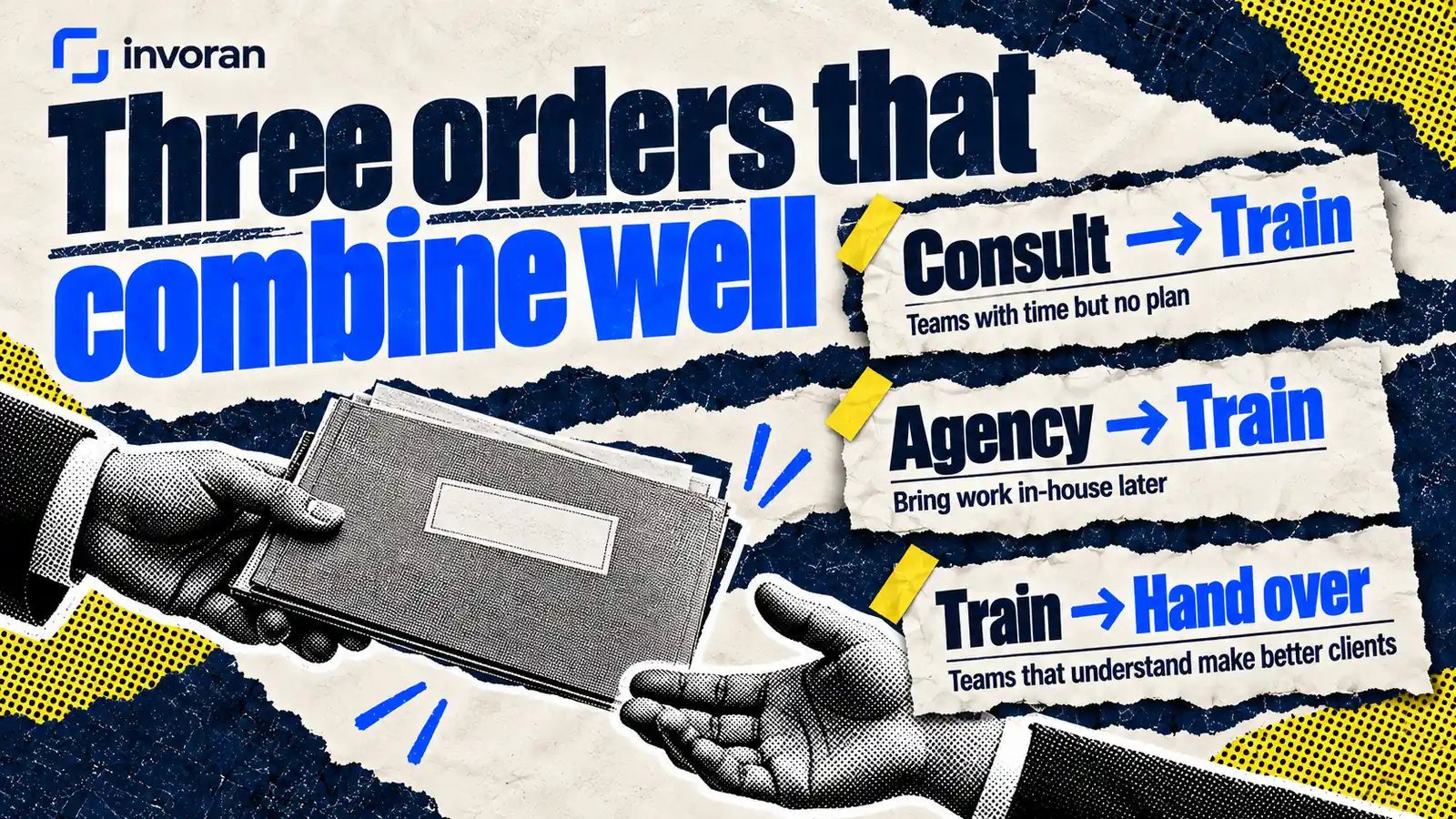
- Consult, then train. Decide which jobs to change first, then train the people who will do them. This suits teams with time but no plan.
- Agency, then train. Hand production over now, and train your team as the work grows so you can bring some of it back in-house later.
- Train, then hand over. Learn enough to brief and judge AI work, then let an agency produce at volume. Teams that understand the work make better clients.
New to AI in marketing? Start with my guide on how to use AI in marketing, then come back to the Four-Column Test.
Frequently asked questions
What is the difference between an AI marketing consultant and an AI marketing agency?
An AI marketing consultant helps you decide how to use AI and leaves the work to your team, while an AI marketing agency produces the work for you. A consultant usually charges by the hour or project; an agency usually charges a monthly retainer. Choose based on who will do the work next month.
How much do AI marketing consultants charge?
There is no reliable single market rate, because published averages mix software projects with marketing advice. Compare quotes in the same unit: the price of a written plan and the price of each month of help after it. Then check what each quote excludes, such as tool subscriptions, ad spend and production work.
Is an AI course enough to start using AI in marketing?
A course is enough if someone on your team has time to apply it to real work right away. Free resources such as OpenAI Academy cover the basics. Without real material and a clear first job to practice on, it's easy to finish a course and keep working the way you did before.
Do I need an AI certificate for my team?
Usually not. What matters is whether people can brief AI tools, judge the output and fix it. In the European Union, the European Commission's AI literacy FAQ states that no certificate is needed under Article 4 of the AI Act; organizations can keep an internal record of training and other initiatives instead.
Can one person be both a consultant and an agency?
Yes. Some independent specialists advise on strategy and also produce the work. In my case, I take hourly work, produce monthly marketing as a service and train teams, and I work with a maximum of five service brands at a time. Ask anyone offering both roles who actually does the production.
How do I know whether I need a consultant or training?
Ask whether your team needs decisions or skills. If people don't know which jobs to change or which tools to use, start with a consultant. If they know what to do but not how to do it well with AI, choose hands-on training built on your own work.
Conclusion: decide by who will do the work
A consultant gives you decisions, an agency gives you output, and training gives your people the skill. Run the Four-Column Test, pick the option that matches who will actually do the work next month, and add a second one later if the work grows.
If you'd like to run the test on your own situation, send me a message on WhatsApp. The first 15 minutes are free, and we'll work out whether hourly help, services, training or a mix makes sense.
Sources
- OpenAI — Scaling the OpenAI Academy (March 25, 2025)
- Anthropic — Learn (Anthropic Academy courses), checked October 14, 2026
- European Commission — AI literacy: questions and answers (last updated July 27, 2026), checked October 14, 2026
- US Bureau of Labor Statistics — Market Research Analysts (May 2025 pay data), checked October 14, 2026
- Pratik10 Instagram account data, October 2026 (internal record).
- Invoran prices and background: invoran.com pricing, services, AI training and about pages, checked October 14, 2026.