Last updated: October 17, 2026
How much a website costs for a small business depends on seven things: how many pages it has, who writes the copy, whether the design is a template or built for you, what it needs to do (forms, booking, calculators), whether it sells online, whether measurement is set up, and what support you get after launch. On top of the build, you pay every year for a domain, hosting and any licenses. Two quotes for "a small business website" can describe very different jobs, so compare what's included, not just the number.
I'm not going to quote a market price range here. Prices move with scope, provider and region, and a range without a written scope doesn't help you decide. Instead, this guide breaks down what drives website design cost, which running costs tend to stay hidden, and what to ask before you sign. I'll also state my own price plainly.
In short:
- Compare scope, not totals. If pages, copy, design and features aren't written down, two quotes aren't describing the same work.
- Separate one-time and yearly costs. Domains, hosting and licenses renew; ask for the renewal price, not just the first-year price.
- Ownership is part of the price. The domain should be registered to you, and source files and admin access should be handed over.
- A cheap website can cost more later. A site you can't move is a site you'll eventually rebuild.
What drives website design cost? The seven line items
When I read a website quote, I check whether each of these seven items is written down. A missing item is either not included or will be billed later.
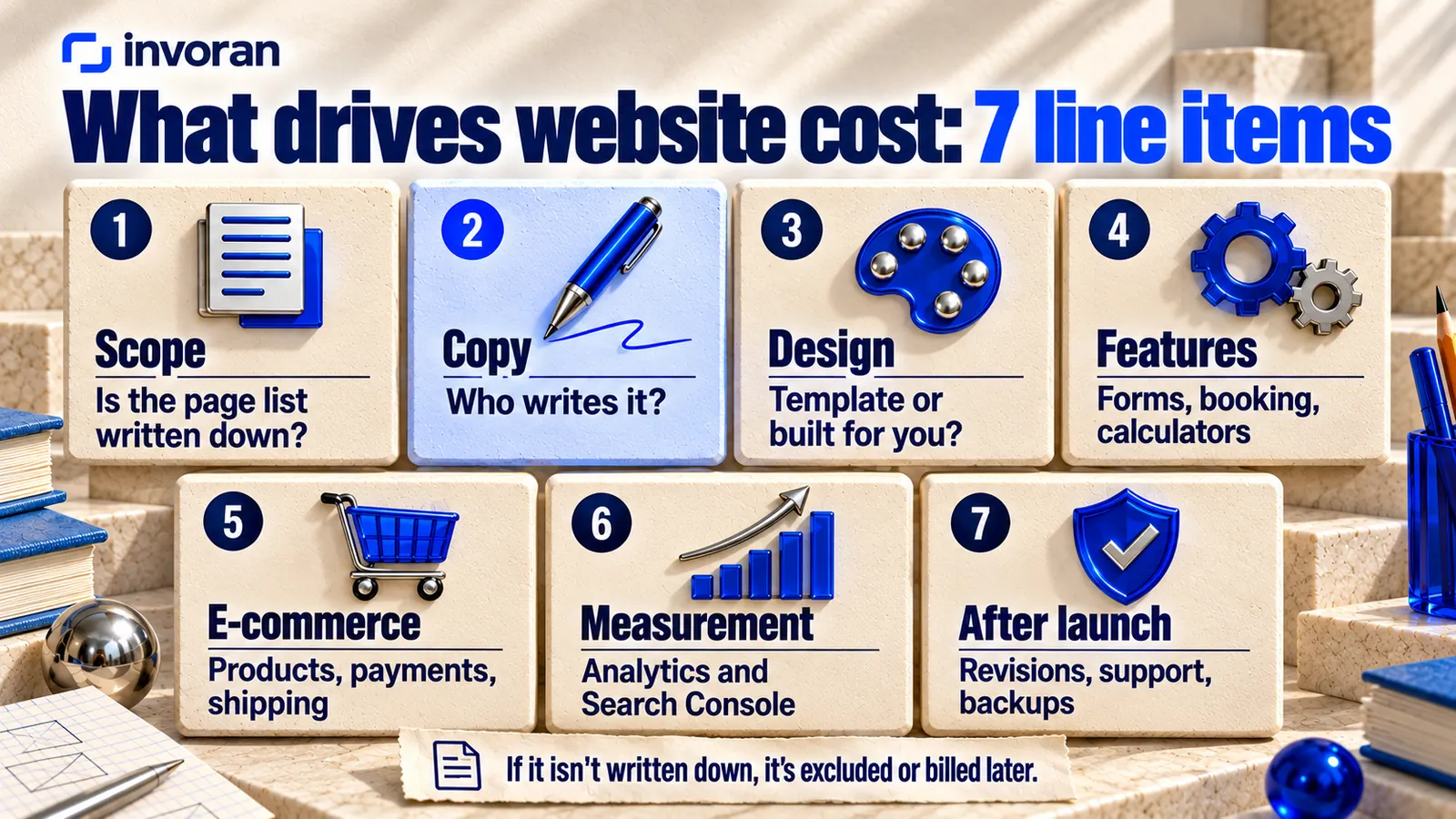
- Scope and page count. A five-page brochure site and a site that explains every service on its own page are different jobs. The quote should list the pages by name: home, services, about, contact, blog and so on.
- Copy and content. Who writes the words? Will you supply them, or will the designer write them? Are product photos, logo and documents ready? A large part of the price gap hides here; a quote without copywriting leaves the hardest part of the site to you.
- Design. Dropping a logo and colors into a template, adapting a template, and designing around your product from scratch are three different workloads. Templates aren't bad; you just say only as much as the template lets you say.
- Features and integrations. Contact forms, booking, a chat or WhatsApp link, calculators, multiple languages, a CRM or email tool connection. Each one is its own setup and its own test.
- E-commerce. Number of products, payments, shipping and inventory change the size of the job. Don't compare an online store against a brochure site on the same line.
- Measurement and search. Google Analytics and Search Console, page titles and descriptions, speed and mobile layout. Without measurement, you can't tell whether the site works.
- After launch. How many revision rounds? How many months of support? Who handles updates and backups? If the quote doesn't answer these, the first problem comes with an extra invoice.
How much does a website cost to run? One-time vs. yearly costs
The number on the quote is often just the build. As long as the site is live, some costs come back every year, and many of them arrive at an introductory price in year one and at a renewal price after that.
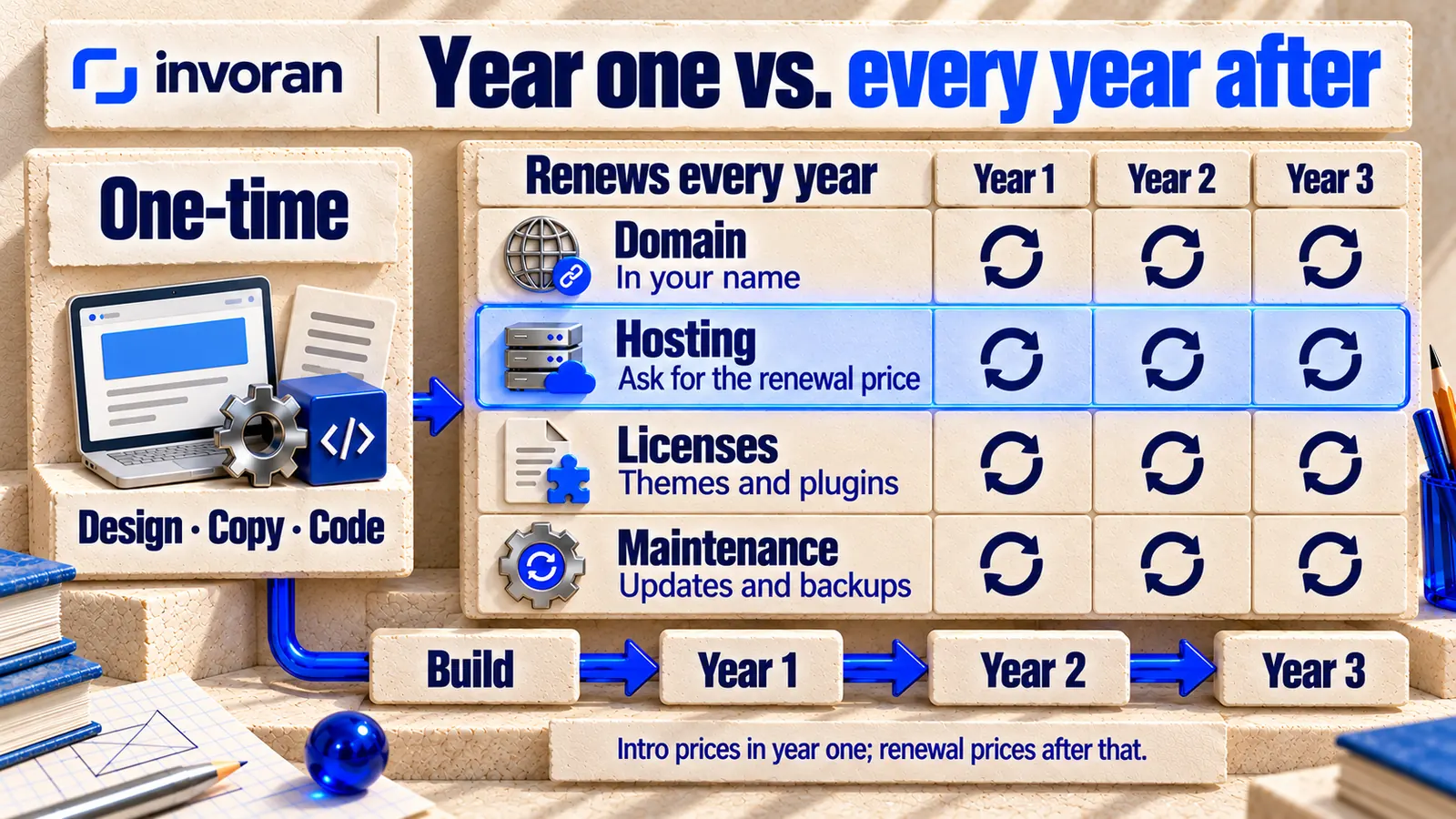
| Item | When you pay | Who should own it | What to ask |
|---|---|---|---|
| Build: design, copy, code | One-time, or inside a monthly service | Source files handed to you | Which pages and features are in scope? |
| Domain name | Every year | Registered in your name | What's the renewal price, and whose name is it in? |
| Hosting | Monthly or yearly | Account in your name, or you have access | Is the renewal price different? Are backups included? |
| SSL certificate | Included with most hosting | In the hosting account | Is it charged separately? |
| Theme and plugin licenses | Often yearly | Licensed to you | Which paid licenses are used, and who renews them? |
| Maintenance and updates | Monthly, yearly or per job | A written responsibility | Who runs updates and backups? |
| Ad spend | While campaigns run | Ad account in your name | Is it included or separate? |
The "who should own it" column matters as much as the price. If the domain is registered to the agency, or you can't log in to the hosting account, you lose your leverage the day you want to move.
Website builder, one-off project or monthly service? Three routes
A small business that needs a website usually has three routes. The question isn't which one is cheapest; it's which one fits how you work.
| Website builder (subscription) | One-off project | Monthly service | |
|---|---|---|---|
| How you pay | Monthly or yearly subscription | Project fee + yearly costs | Monthly fee + yearly costs |
| Who builds it | Usually you, from a template | An agency or freelancer | The person or team providing the service |
| Flexibility | As much as the platform allows | Depends on scope | Depends on scope; updated continuously |
| Portability | Leaving often means rebuilding | High, if source files are handed over | High, if source files are handed over |
| Best for | Owners who want to run the site themselves | A site built once that rarely changes | Companies that want site, content and marketing run together |
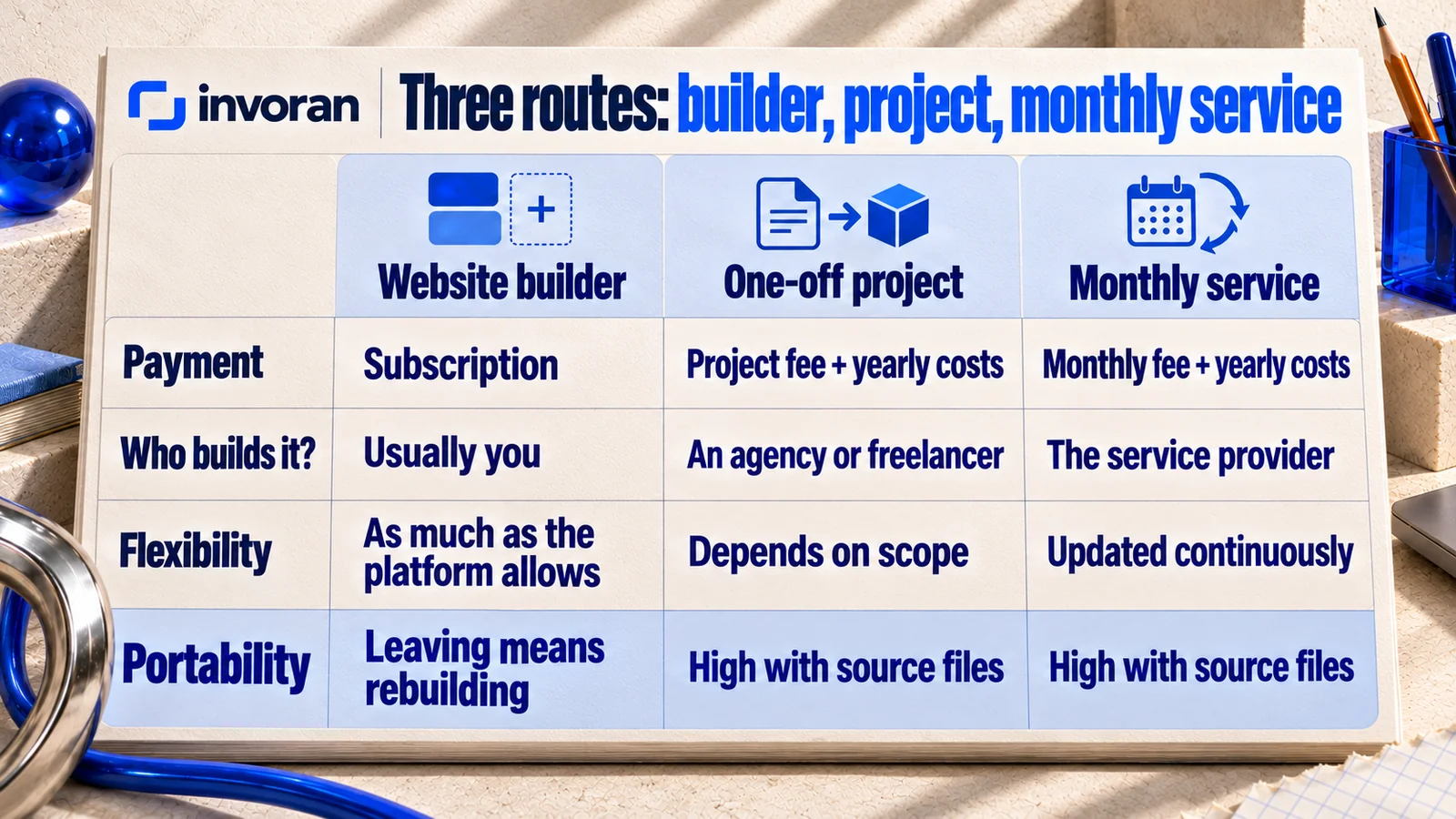
A builder subscription often looks like the lowest starting cost, and for an owner who wants to run the site personally it can be the right call. Keep in mind that you pay for as long as the subscription runs, and moving off the platform usually means rebuilding the site.
How to compare website quotes: a ten-question checklist
You have three quotes and the totals are far apart. Before you look at the numbers, send each provider the same ten questions:
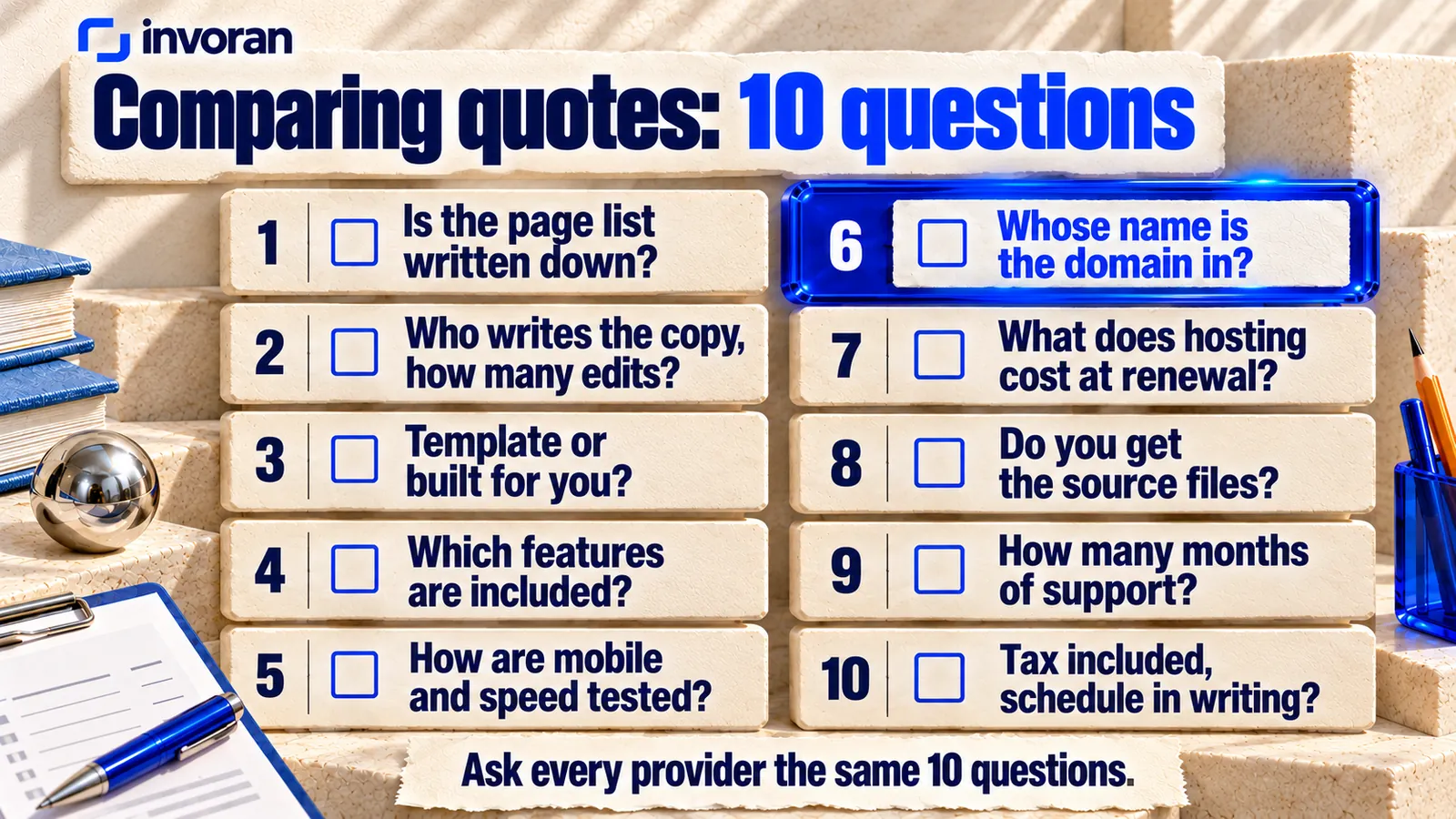
- Which pages will be built? Is the list written down?
- Who writes the copy, and how many rounds of edits are included?
- Is the design a template, an adapted template or built for you?
- Which features are included: forms, booking, calculators, languages?
- How will mobile layout and speed be tested?
- Whose name will the domain be registered in, and what does renewal cost?
- What does hosting cost in year one and after, and are backups included?
- Will you get the source files and admin access at handover?
- How many months of support and updates come after launch?
- Is tax included, and is the delivery schedule in writing?
The speed question isn't a formality. Google publishes "good" thresholds for its Core Web Vitals: the largest content element loading within 2.5 seconds, interactions responding in under 200 milliseconds, and layout shift staying below 0.1. You can ask a provider whether they'll show you those measurements at handover.
Why a cheap website can cost more
A low quote isn't a red flag on its own. The red flag is a low quote that doesn't say what it leaves out. The six situations I see most often:
- The domain is registered to the agency. Getting it back when you leave becomes a negotiation.
- No source files or admin access. The site is yours, but the right to change it isn't.
- A yearly "package" renewal. Low in year one, then hosting, maintenance and licenses rise together on one invoice.
- Template copy. Sentences that appear on other sites describe you to neither customers nor search engines.
- Slow and cluttered on mobile. Many visitors open the site on a phone; mobile testing should be in the quote.
- No measurement. Without Analytics and Search Console, you can't see who the site brings in or what it does.
What I charge, and what's included
Here's my own pricing, stated plainly. The website is part of my monthly service: $750 + VAT per month. It covers a custom-coded website, 300–500 personalized emails a month, 12 AI videos a month, a monthly content plan and publishing across six channels. There's no lock-in; you can stop in any month.
Domain, hosting and any required licenses aren't included; we agree them before we start. Page count, integrations, delivery schedule, revisions and account access are written down before work begins, and when the service ends, all website source files are handed over to you in full. I don't publish a separate price for a standalone website project; work outside the packages is $100 + VAT per hour.
I build sites with Claude Code, coding the page structure, calculators and interactions myself, and set up WordPress where it fits. You can see how I work in my website design services, the full packages on the pricing page, and finished projects on the work page.
Before you ask for quotes: four steps
Four pieces of preparation make quotes comparable and usually lower, because every unclear point gets priced in as a buffer.
- Write down what the site is for. What should a visitor have done before leaving: called, filled in a form, bought something? Pick one main goal.
- List your visitors' questions. What do customers ask most on the phone? Your page headings come from those questions.
- Make a page list and an asset inventory. Which pages do you need, and are the logo, photos, product facts and references ready?
- Ask three providers for quotes on the same scope. Send each the same page list and the ten questions above, and ask for written answers.
If you want to draft the copy or page structure yourself with AI first, the website workflow in Claude AI for marketing and the overview in how to use AI in marketing are good places to start.
Frequently asked questions
How much does a website cost for a small business?
It depends on page count, who writes the copy, template versus custom design, features, e-commerce, measurement setup and post-launch support, plus yearly domain, hosting and license costs. In my case, the website is part of a $750 + VAT monthly service. Compare quotes by their written scope rather than their totals.
How much does a website cost per month?
Running costs usually include hosting, a yearly domain renewal, any paid theme or plugin licenses and maintenance, and many of them cost more at renewal than in year one. Ask every provider for renewal prices in writing. With a monthly service, check which of these sit inside the fee and which stay with you.
Why do website design quotes vary so much?
Because the same label covers different work. One quote may mean dropping a logo into a template; another may include copywriting, custom design, calculators and measurement. Unless pages, copy, design type, features, revisions and support are written down, two quotes can't be compared.
Are domain and hosting included in the price?
Often not, or only for the first year. Both renew every year, and the renewal price can differ from the introductory one. Ask whose name the domain will be registered in; it should be yours.
Should I use a website builder or hire a designer?
A builder can be enough for an owner who wants to run a small site personally; you pay for as long as the subscription runs, and leaving usually means rebuilding. If you need to explain your product in your own way or add tools like calculators, a custom build is the better fit.
Is a website built with AI cheaper?
AI speeds up coding and copy drafts; I build sites with Claude Code myself. A person still has to decide what the site says, which pages it needs and whether it works, and then test it. AI makes the work faster; it doesn't remove scope, checking or responsibility.
Bottom line: compare the scope, not the total
The quickest way to compare website quotes is to send every provider the same page list and the same ten questions. Separate the one-time build from the yearly domain, hosting and license costs, and make sure the domain is in your name and the source files come to you at handover. The cheapest quote isn't the lowest number; it's the one whose scope is written down and whose site you can take with you.
If you'd like to map out your site's scope together, send me a message on WhatsApp; the first 15 minutes are free.
Sources (accessed October 17, 2026)
- Google Search Central — Understanding Core Web Vitals and Google search results
- Google Search Central — Understanding page experience
- Google Search Central — How to use Search Console
- Invoran pricing page and service terms (October 2026)