Last updated: October 14, 2026
There is no single AI disclosure law for advertising. In the US, no federal rule says "label every AI ad," but the FTC applies its existing rules: an AI presenter can't pose as a real customer without a clear disclosure, and it can't claim to have used your product. New York now requires ads to disclose AI-made "synthetic performers."
In the EU, Article 50 of the AI Act has applied since August 2, 2026: if you publish a deepfake, meaning AI image, audio or video that resembles existing people, places or events and would falsely appear authentic, you must disclose it clearly, at the latest when the viewer first sees it. The UK has no blanket AI disclosure requirement, but the advertising regulator says a label won't rescue a misleading ad. On top of the law, YouTube, TikTok, Meta and Google Ads each run their own AI labels.
Below is a market-by-market summary and the ten-point check I run on every AI-made ad. This guide covers advertising and marketing content only. I produce AI video ads; I'm not a lawyer.
In short:
- Realism is the trigger. Most rules care about AI that could pass for a real person, place or event, not AI used behind the scenes.
- Testimony is the red line. An AI person can explain a product. It can't claim to have used it.
- Put the disclosure inside the ad. Platform labels are an extra layer, not a substitute.
- Build for the strictest market the ad runs in.
What do AI disclosure laws cover, and which apply to ads in 2026?
Search results for "AI disclosure laws" mix four topics:
- Ads and marketing content with AI people, voices or scenes. That's this guide.
- Chatbots that talk to customers. In the EU, providers must build them to say they're AI. In the US it goes state by state: Utah's SB 226, in effect since May 7, 2025, requires a business using generative AI with consumers to disclose it when a person clearly asks if it's AI.
- Election ads. Separate rules apply; Google Ads, for example, requires its "Altered or synthetic content" setting for election ads with synthetic content.
- Claims about a company's own AI, to investors or in patent filings. Different law, not covered here.
For ads, AI disclosure requirements come from consumer protection law, a few AI-specific rules and platform policies. The law:
| Market | Rule | What triggers a disclosure | In force |
|---|---|---|---|
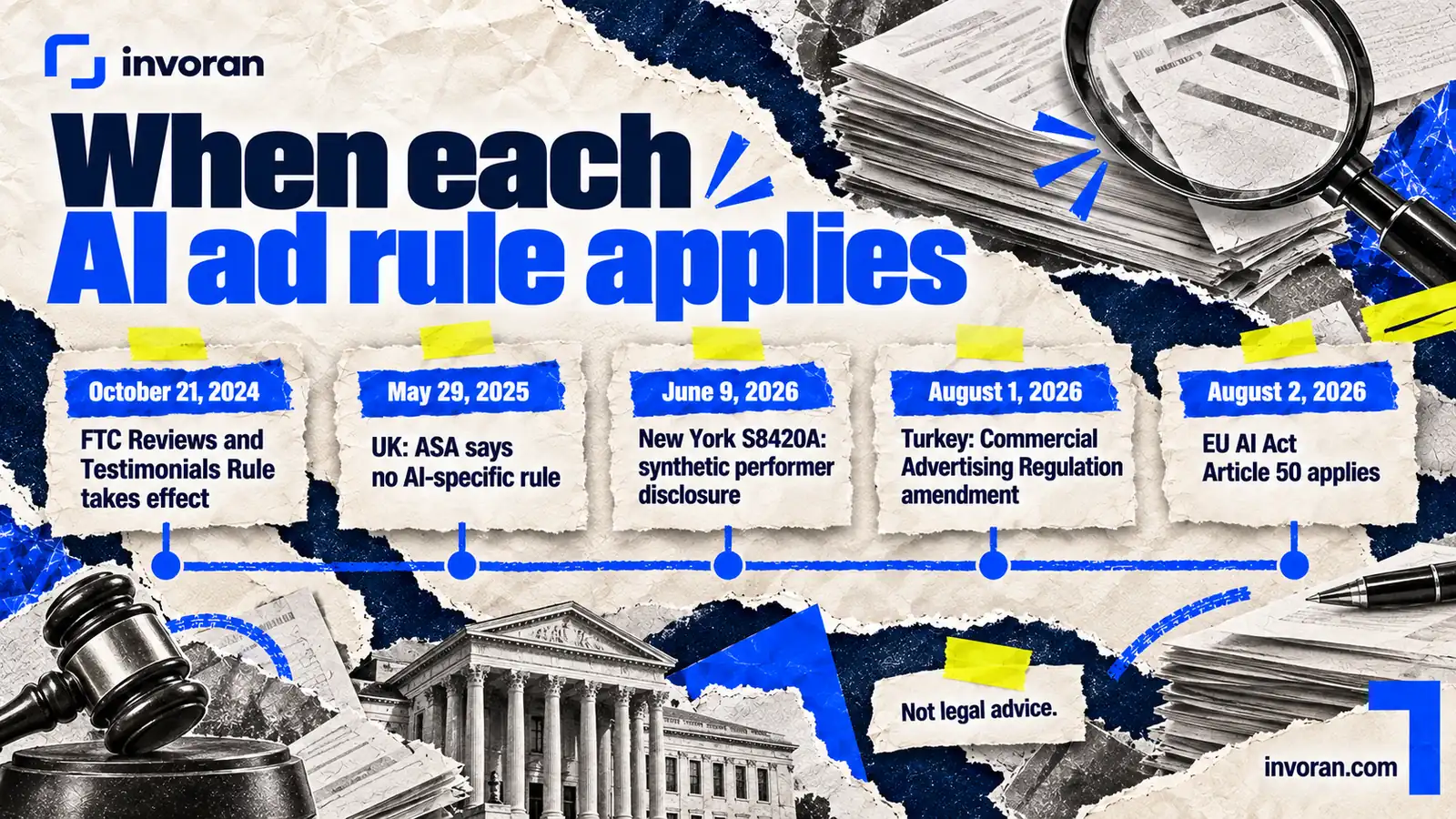
| US (federal) | FTC Act, Endorsement Guides, Reviews and Testimonials Rule | AI people presented as actual consumers or users; fake testimonials | Reviews rule since October 21, 2024 |
| New York | S8420A (General Business Law § 396-b) | A commercial ad that includes a "synthetic performer," when the creator knows it | June 9, 2026 (signed December 11, 2025) |
| European Union | AI Act Article 50 | Deepfake image, audio or video; some AI-written public-interest text | August 2, 2026 |
| United Kingdom | CAP and BCAP Codes, enforced by the ASA | No AI-specific rule; disclose when the audience would otherwise be misled | ASA article published May 29, 2025 |
| Turkey | Commercial Advertising Regulation amendment | Human-like AI characters; AI use that materially affects buying decisions | August 1, 2026 |
Do you have to disclose AI in ads in the US?
Not as a blanket rule, but existing FTC rules reach most risky uses. Announcing Operation AI Comply on September 25, 2024, the FTC's then-chair said there is no AI exemption from the laws on the books.
Four rules matter for ads:
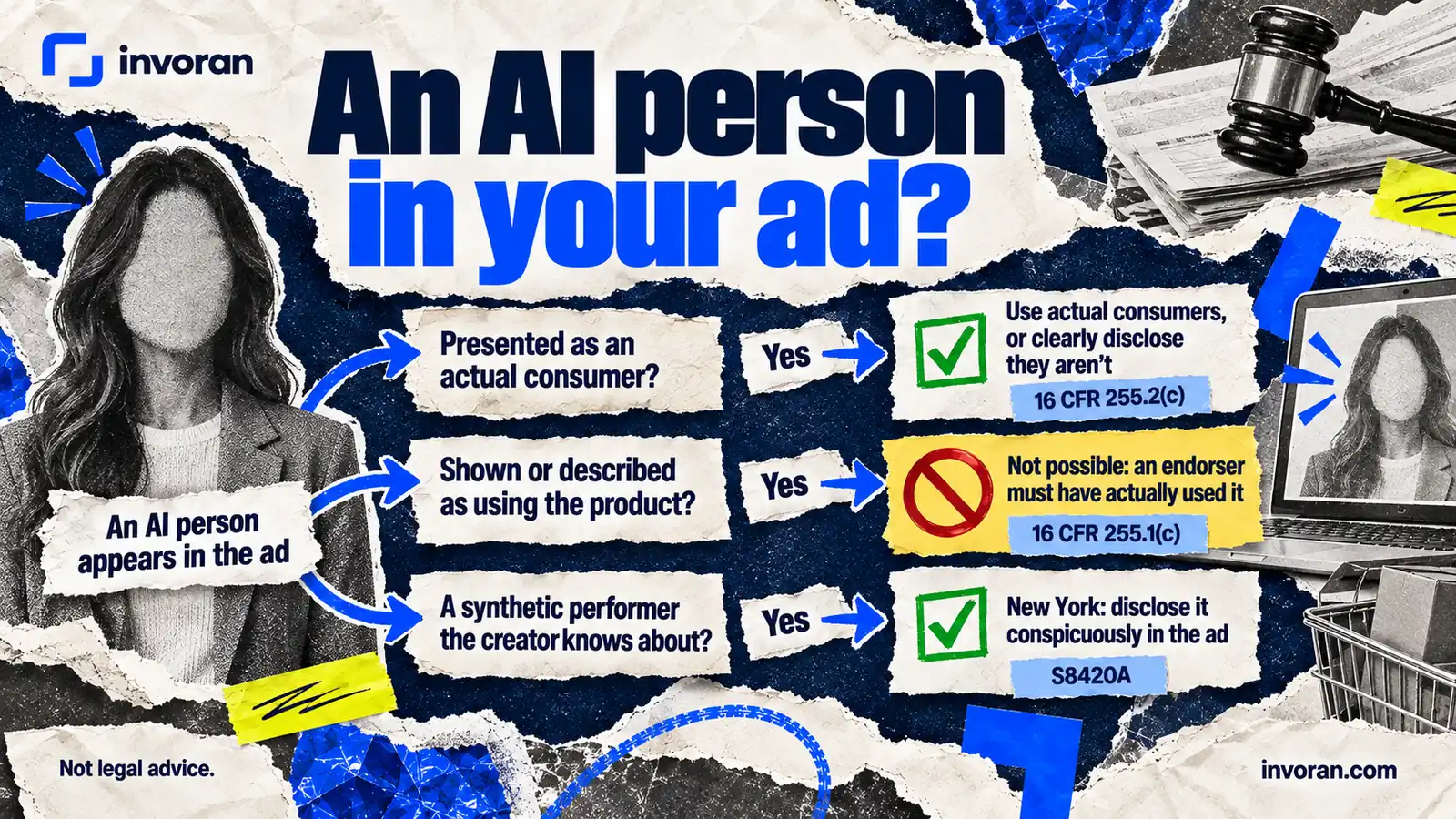
- Actual consumers. Under 16 CFR 255.2(c), endorsements by people presented as "actual consumers" should use actual consumers, or clearly and conspicuously disclose that they aren't. An AI avatar framed as a customer falls here.
- Bona fide use. Under 16 CFR 255.1(c), an endorser shown using a product must have actually used it.
- Fake testimonials. The Consumer Reviews and Testimonials Rule took effect on October 21, 2024. The FTC's Q&A says it doesn't ban AI avatars outright, but an avatar's lines can count as a testimonial, prohibited if the underlying testimonial is fake. Courts can impose civil penalties for knowing violations.
- New York's synthetic performer law. S8420A, in effect since June 9, 2026, says anyone who creates a commercial ad knowing it includes a synthetic performer (an AI-made human performer not recognizable as any real person) must disclose that conspicuously in the ad. Fines are $1,000 for a first violation and $5,000 for each later one.
The most useful yardstick for any AI disclosure is the FTC's definition of "clear and conspicuous" in 16 CFR 255.0(f): difficult to miss, easily understood by ordinary consumers, shown and spoken when the claim is made both ways, and unavoidable on social media. A label buried in a menu doesn't meet that bar. For the UGC format, see my guide to AI UGC ads.
What does EU AI Act Article 50 require from advertisers?
According to the European Commission's FAQ on EU AI Act Article 50 (updated July 24, 2026), these duties matter for marketing:
- Deployers disclose deepfakes. Whoever uses an AI system to publish a deepfake, AI-generated or manipulated content that resembles existing persons, objects, places or events and would falsely appear authentic, must disclose it clearly and distinguishably, at the latest at first exposure. Evidently artistic or satirical work gets a lighter disclosure that doesn't spoil it.
- Outsourcing doesn't move the duty. The FAQ's own example is an advertising company: it remains a deployer even when contractors or freelancers help operate the AI system. My reading: hiring someone to make your ad doesn't hand them your disclosure duty.
- Some AI text needs a label. AI text published to inform the public on matters of public interest must be labeled, unless a person reviewed it and holds editorial responsibility.
- Chatbots and avatars say they're AI. Providers of chatbots and AI avatars must design them so people are told they're interacting with an AI system, unless it's obvious, an exception the FAQ says to read narrowly. Check this when you pick a chatbot or avatar tool.
- Tool makers mark the files. Providers must mark output in a machine-readable way (older systems have until December 2, 2026). Those hidden marks don't replace your visible disclosure.
Fines can reach 15 million euros or 3% of worldwide turnover.
What stays unclear: whether a stock AI presenter who resembles no real person counts. I don't wait for that answer. If the presenter looks real, I disclose.
How do the UK and Turkey handle AI disclosure in ads?
United Kingdom. The ASA wrote on May 29, 2025 that the CAP and BCAP Codes contain no AI-specific rules and that there is no blanket legal requirement in the UK to disclose AI use in ads. The test is whether the audience is likely to be misled without a disclosure. Its sharpest point: disclosure alone is very unlikely to fix a fundamentally misleading message, such as an AI image showing a cosmetic effect the product doesn't deliver.
Turkey, for comparison. The rule where I work, in Ankara, is broader than New York's. An amendment to Turkey's Commercial Advertising and Unfair Commercial Practices Regulation (Official Gazette No. 33297, July 1, 2026) took effect on August 1, 2026. It requires a clear, understandable and distinguishable disclosure for AI characters indistinguishable from humans and for AI use that materially affects buying decisions. It bans outright any ad in which an AI copy of a real person falsely appears to use or recommend a product. Influencer ads must also be labeled, for example with "Reklam" or "Tanıtım" plus the advertiser's name, visible without scrolling. Details are in my Turkish guide, yapay zeka reklam beyan zorunluluğu.
Is a platform's "AI-generated" content label enough?
No. A platform's AI-generated content label doesn't replace a disclosure inside the ad, and several sit where viewers rarely look.
What each official page said when I checked on October 14, 2026:
| Platform | What it asks or does | Where the label shows |
|---|---|---|
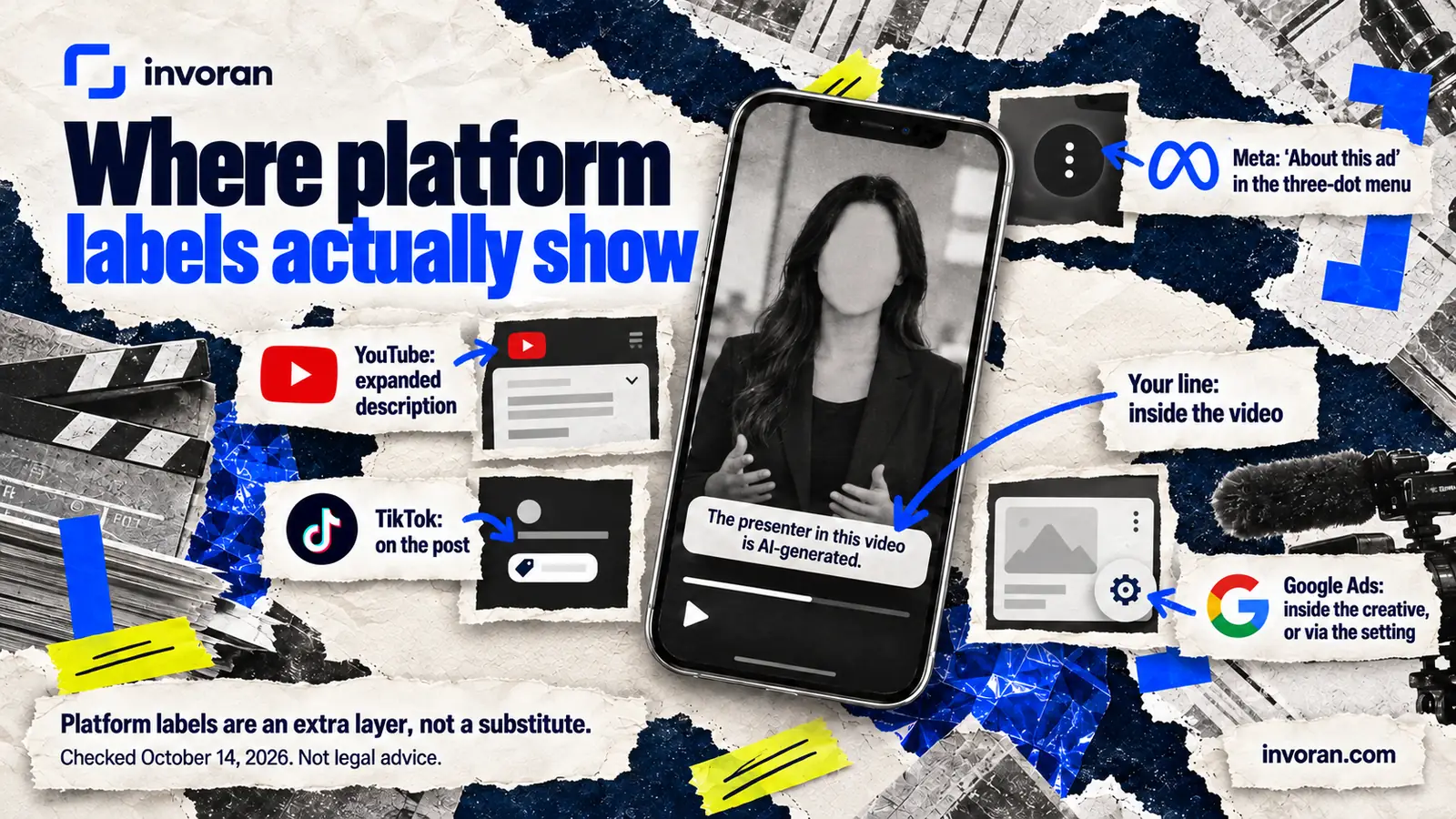
| YouTube | Disclose realistic altered or synthetic content, such as a real person doing what they didn't or a realistic scene that never happened | Expanded description; for photorealistic content or AI music, possibly the player |
| Google Ads | Since a July 9, 2026 update, advertisers can put AI labels inside image and video creatives or use an AI label setting | Inside the creative, or via the setting |
| Meta (Facebook, Instagram) | "AI info" label on ads made or significantly edited with Meta's own AI tools; Meta says it will detect third-party tools through industry signals | "About this ad" in the three-dot menu; next to "Sponsored" for photorealistic AI people. May vary by region |
| TikTok | Creators must label AI content showing realistic-appearing scenes or people. Non-Spark ads fully or significantly AI-made use the "This ad contains AI-generated content" toggle | On the post |
So the AI-generated label on Instagram may sit one tap away, and YouTube's in the description. Neither is "unavoidable" in the FTC's sense, so I still put my own line in the video.
What should you check before an AI ad goes live? The Ten-Point AI Disclosure Check
I run this check on every AI video I make. It covers six areas: person, voice, visuals, placement, platform, records. It's a production habit, not a legal review.
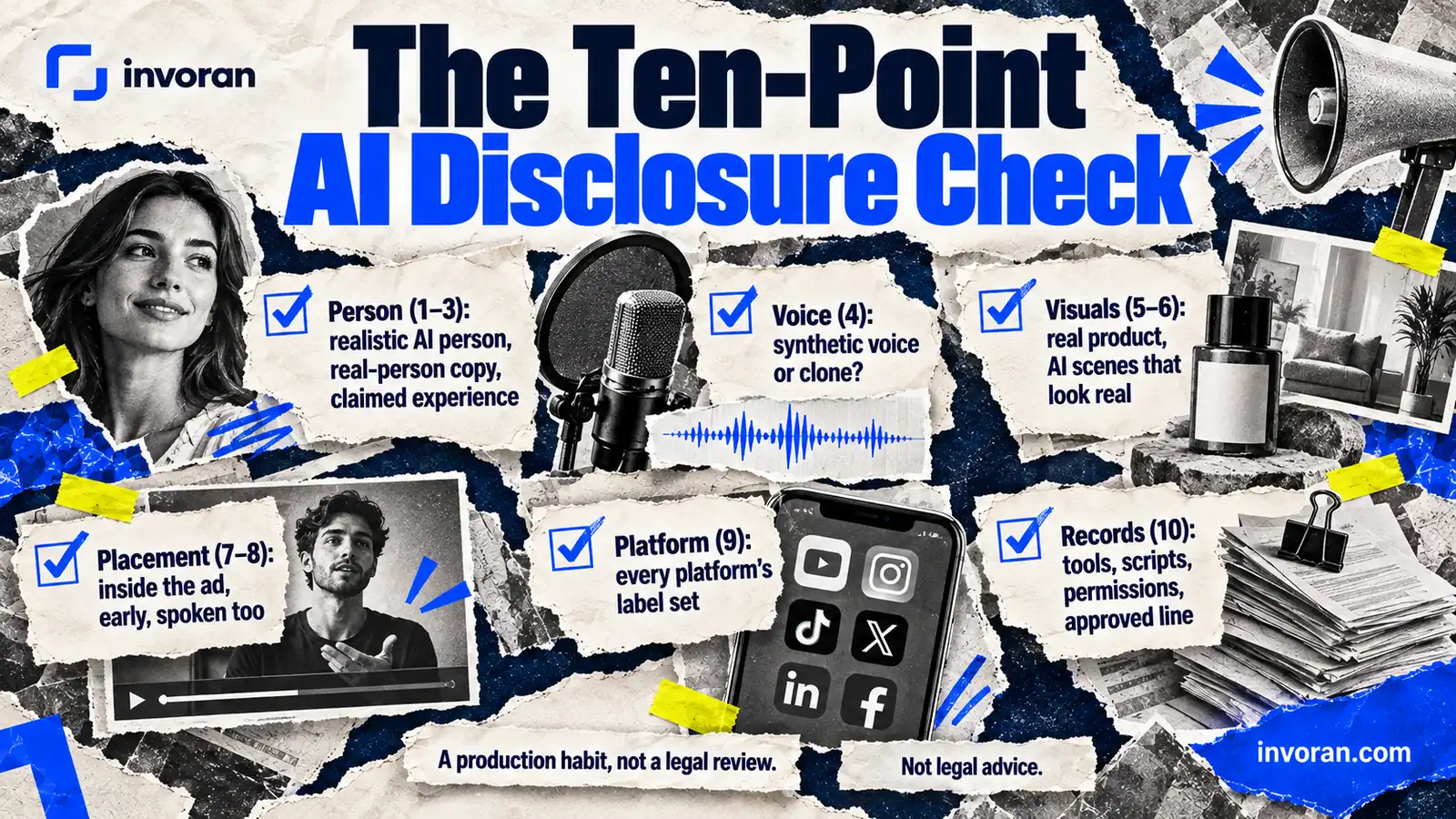
Person
- Is there an AI person realistic enough to pass as human? Then disclose. If I'm unsure, I treat the answer as yes.
- Is it a digital copy of a real person? Then I need written permission and proof they actually use the product. Missing either, the ad isn't made.
- Does the AI person describe an experience? "I've used this for three weeks" from someone who doesn't exist is a fake testimonial, label or not. I write "this product does" scripts.
Voice
- Is the voice synthetic or a clone? A clone needs the owner's written permission and true lines. A synthetic voice playing a realistic character gets disclosed.
Visuals
- Is the product the real product? Color, size, texture and promised result must match what the customer receives.
- Is an AI scene presented as a real place, event or crowd? If it looks real, it gets disclosed.
Placement
- Is the disclosure inside the ad, early, and readable without scrolling or tapping? A line hidden in the caption or the last frame doesn't count.
- Is it spoken too when the ad is audio-led? Listeners need to hear it.
Platform
- Is every platform's label set? YouTube's disclosure, the Google Ads label, TikTok's label or toggle, plus a paid-partnership label when a creator posts it. On Meta, check the AI info label Meta applies itself.
Records
- Is the file kept? Tools, source images, scripts, permissions, the approved disclosure line, and who approved it when. I use Higgsfield for images and video, Google Flow and Nano Banana for still frames, ElevenLabs for voice and Suno for music, so each clip's tool goes in the record.
Representative example: a skincare brand wants an ad with a photorealistic AI presenter. Point 1 says disclose. Point 3 cuts "my skin changed in two weeks." Point 5 swaps an AI-redrawn jar for the real product photo. Point 7 puts "The presenter in this video is AI-generated" on screen from the first second. This is an illustration, not a client result.
Where should an AI disclosure go, and what should it say?
No law I've cited gives a ready-made sentence or size, so I use the FTC's "clear and conspicuous" definition, the most concrete one, as my working standard:
- Where: inside the video, in the upper or middle band, not the bottom strip that app buttons cover.
- When: from the moment the AI person or scene appears, long enough to read.
- Language: the ad's own language.
- Sound: spoken as well when the ad relies on voiceover.
Sample lines I use (my wording, not official templates):
- "The presenter in this video is AI-generated."
- "This ad uses AI-generated images and voice. The product shown is real."
- "Scenes created with AI from photos of the real product."
Use the second only when the product footage is genuinely unaltered.
In my own work the disclosure is part of the edit: I do the editing, subtitles and assembly with Claude (see Claude AI for marketing), so the disclosure goes in with the subtitles. Every video in my AI content and video production work goes through the ten-point check, features the client's actual product, and is checked by hand before it reaches a channel.
Which AI uses don't need a label, and what can't a label fix?
Over-labeling has a cost: viewers learn to ignore it. These uses usually don't trigger a disclosure on their own:
- AI behind the scenes: brainstorming, script drafts, research.
- Beauty filters and color or lighting corrections (YouTube's own examples).
- Clearly unrealistic or animated content.
- In New York, audio-only ads and pure translation of a human performer. The EU's deepfake rule still covers realistic AI audio.
And these problems survive any label:
- A product that looks better than it is. The ASA's cosmetic example. Fix the ad instead; my guide to turning a product photo into an AI video shows how to keep the product real.
- A fake testimonial. Covered by the FTC rules above; TikTok also bans AI content falsely showing public figures endorsing.
- An AI copy of a real person recommending something they don't use. Banned in Turkey, and a likely problem everywhere.
My rule for the gray zone: when in doubt, disclose. It costs a few words.
Frequently asked questions
Is there a federal law requiring AI disclosure in US ads?
No, there is no single federal law requiring a label on every AI ad. The FTC applies existing rules: endorsements framed as actual consumers need real consumers or a clear disclosure, endorsers must have used the product, and fake testimonials are banned. New York adds a synthetic performer disclosure law.
What is EU AI Act Article 50?
EU AI Act Article 50 is the transparency rule for AI interactions and AI-generated content, applying from August 2, 2026. For advertisers, the key duty is disclosing deepfakes clearly at the latest at first exposure. It also covers some AI-written public-interest text, chatbots and machine-readable marking by tool providers.
Do I need an "AI-generated" label on Instagram ads?
Meta may label your ad, but that label is an extra layer, not your disclosure. It covers ads made or significantly edited with Meta's own AI tools, plus third-party tools Meta says it will detect, and sits in the "About this ad" menu. That's easy to miss, so add your own on-screen line for a realistic AI person.
Does using AI to write ad copy need a disclosure?
Usually not, if a person reviews the copy and it makes no false claims. The rules above target realistic synthetic people, scenes and voices, and fake testimonials. The EU's text rule targets unreviewed AI text on public-interest matters, so reviewed product copy is unlikely to fall under it. Turkey's broader trigger is untested.
Can an AI avatar give a testimonial in an ad?
No, not as a genuine testimonial. Under the FTC's Endorsement Guides, an endorser who claims to use a product must have actually used it, and an AI avatar can't. An avatar can explain what a product does, with a clear disclosure, but shouldn't describe results or feelings as its own.
The bottom line: disclose realism, never fake testimony
AI disclosure laws differ by market, but they point the same way. If AI could pass for a real person, place or event, say so inside the ad, early and plainly. Never let an AI person claim an experience that didn't happen. Run the ten-point check before each launch.
Send me a message on WhatsApp; the first 15 minutes are free.
Sources (accessed October 14, 2026)
- FTC — Operation AI Comply (September 25, 2024)
- eCFR — 16 CFR Part 255 (FTC Endorsement Guides)
- FTC — Reviews and Testimonials Rule Q&A
- New York State Senate — Bill S8420A and Cooley on its effective date
- European Commission — Article 50 AI Act FAQ (updated July 24, 2026)
- ASA — Disclosure of AI in advertising (May 29, 2025)
- Resmî Gazete (Turkey) — Advertising Regulation amendment (No. 33297)
- Turkish Ministry of Trade — announcement (July 27, 2026)
- YouTube Help — Disclosing altered or synthetic content
- Google Ads Help — AI labeling update (July 9, 2026)
- Meta Newsroom — Gen AI transparency in ads (updated June 1, 2026)
- TikTok — AI-generated content transparency
- Utah Legislature — SB 226 (2025), enrolled text and Utah Code § 13-77-103
- TikTok Ads Help — Add disclaimers to ads (September 2025)
- Invoran — AI content and video and About