Last updated: October 14, 2026
An AI creative agency produces marketing creative (short videos, images, ad variations and copy) with generative AI tools doing much of the making that a film crew, photographer or design studio used to do. People still own the parts that decide whether the work is any good: the idea, the product facts, the final check and what gets published.
That split is how you tell a good AI creative agency from a weak one. A good one shows you where AI does the work and where a named person takes over, and puts it in the written scope. A weak one sells speed and volume, can't say who checks the output, and hints at reach or sales it can't control. Before you hire, look for real work on real accounts, the tools behind it, and who owns the files when you stop. Below is the map I use to read any proposal, my own included.
In short:
- AI makes, people decide. Generation is the cheap part now; facts, judgment and the final check are where agencies differ.
- "AI-first" is a production method, not a result. Ask what it changes in your scope.
- The price follows the scope. Volume, versions, publishing and separate costs explain most gaps between quotes.
- The rules travel with the ad. US, UK and EU rules apply to AI creative like anything else you publish.
Already have a shortlist? Skip to the checklist and run each name through it.
What does an AI creative agency do?
An AI creative agency takes over the production side of marketing creative and uses AI tools to make more of it, faster, with fewer handoffs. A typical month covers some or all of these:
- Concepts and scripts: angles, hooks and scripts written from your product facts.
- Visuals: product scenes, social images and ad creative built around your real product.
- Video: AI-generated or AI-extended scenes, voiceover, music, subtitles and the final cut.
- Versions: each idea cut for every channel, plus variations for testing.
- Publishing and reporting: posting on your channels and a monthly read of what worked.
Whether an AI creative agency also buys media, runs your ad accounts or builds automations varies from one agency to the next. If a proposal blurs these lines, ask for the deliverables as a list with monthly counts.
The biggest change is the cost of a second try: when a script line changes, an AI workflow can often regenerate the scene instead of booking another shoot day. That makes testing several openings realistic. It doesn't make the first idea better.
How is an AI creative agency different from other "AI agencies"?
"What does an AI agency do?" has no single answer, because the label covers at least four different businesses:
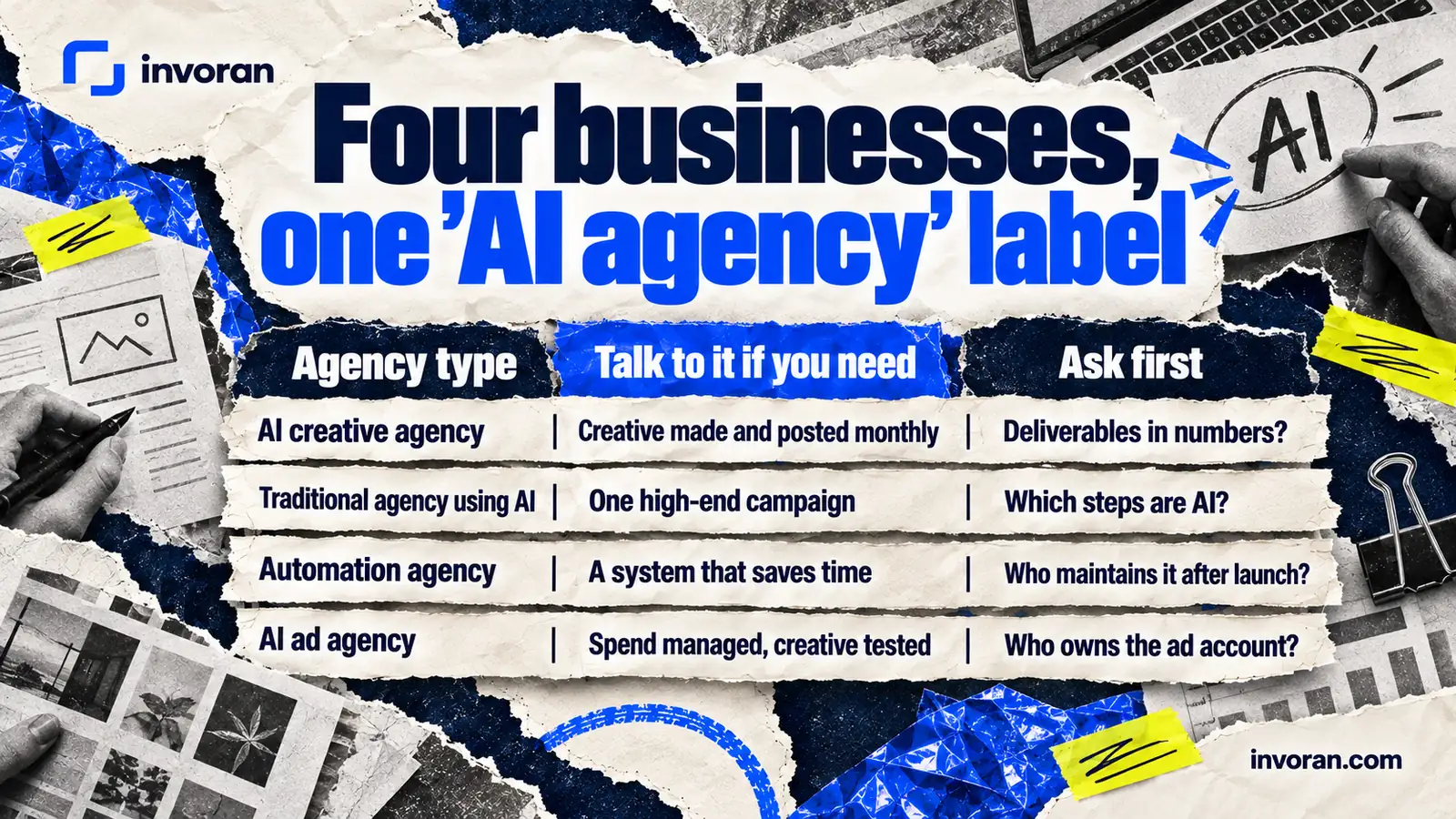
| AI creative agency | Traditional creative agency using AI | AI automation or solutions agency | AI ad (performance) agency | |
|---|---|---|---|---|
| What you get | Videos, images, copy and versions, often published for you | Campaign ideas and polished production, with AI used for some steps | Chatbots, workflows, internal assistants, integrations | Ad creative plus media buying and testing |
| Talk to this one if | You need creative made and posted every month | You need one big campaign with high-end production | You need a system that saves your team time | You need ad spend managed and creative tested |
| First thing to ask | "What do you deliver each month, in numbers?" | "Which steps are AI and which are filmed?" | "Who maintains the system after launch?" | "Who owns the ad account and the data?" |
If you want advice rather than production, my guide on AI marketing consultant vs. agency vs. course covers that case.
What does "AI-first" mean in an agency pitch?
An AI-first marketing agency produces with AI tools by default and brings in filming, photography or human voice only when the job needs them. That should show up as fewer handoffs, cheaper iterations (a new opening line shouldn't cost a new shoot day) and more versions to test, so next month follows what performed. It doesn't mean no people, guaranteed results or the cheapest option, and the label carries no legal weight: the rules below still apply.
Where should AI stop and a person take over? The Creative Chain Map
I read every AI creative proposal against a framework I call the Creative Chain Map. Creative work moves through six links. AI can help at each, but each needs a named owner, and two can never be left to AI alone: Facts and Checking.
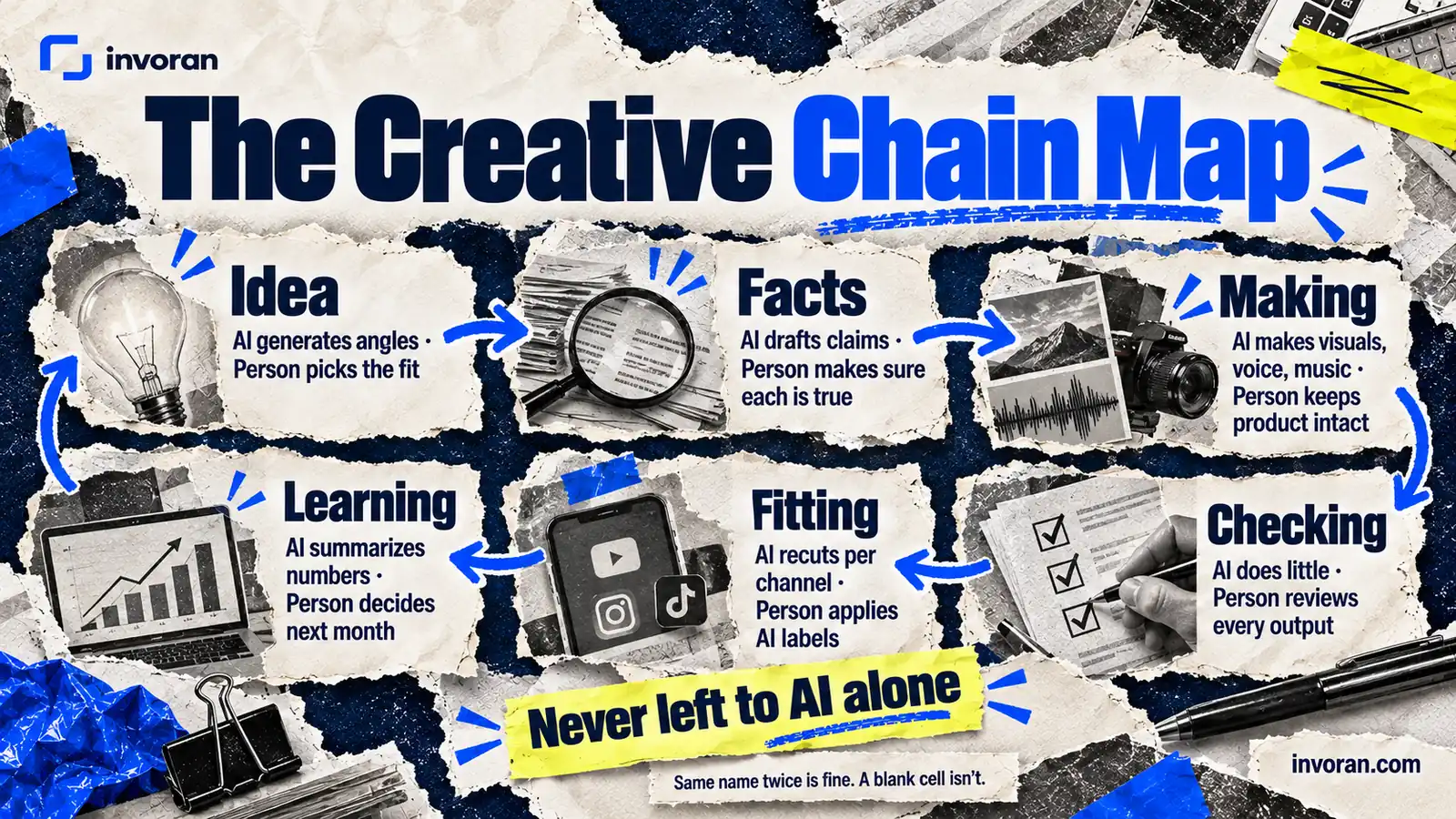
| Link | What AI does well | What a person must own | What to ask to see |
|---|---|---|---|
| 1. Idea | Generates many angles and hooks quickly | Picks the angle that fits your customer and offer | The brief, and why this angle was chosen |
| 2. Facts | Drafts claims and copy from inputs | Makes sure every claim comes from you and is true | The source for each claim in a script |
| 3. Making | Visuals, motion, voice, music, subtitles | Directs the work and keeps your real product intact | The tools and the plans they run on |
| 4. Checking | Little; models can state errors confidently | Reviews every output before it goes anywhere | Who reviews, and where you approve |
| 5. Fitting | Resizes, recuts and captions for each channel | Adjusts tone per channel and applies AI labels | The label plan for each platform |
| 6. Learning | Summarizes numbers | Decides what to change next month | A report with sources and date ranges |
How to score a proposal with it:
- Facts or Checking has no named person: stop there. Volume without a check multiplies mistakes.
- Making names no tools or plans: ask before you sign; commercial rights depend on the plan.
- Every link has an owner, in writing: the decision is now about fit and price, not trust.
A one-person studio names the same person more than once; that's fine. A blank cell isn't.
A worked example: the map filled in for my own work
I run Invoran alone, so most cells carry my name. I'm an industrial engineer, I've run businesses for 13 years with $193K in advertising spend over that time (from my own company records, at the October 2026 exchange rate), and I take on at most five service brands at a time.
- Idea and Facts: I write every script, using AI for drafts. Every fact comes from you; I don't add features or results you haven't provided.
- Making: Higgsfield for AI images and video, Google Flow and Nano Banana for still frames, ElevenLabs for voice, Suno for music. I do the editing, subtitles and assembly with Claude (see Claude AI for marketing). Every video features your actual product.
- Checking: I check every AI output by hand before it reaches your channels, and you approve the publishing plan before anything goes live.
- Fitting: each video is adapted for Instagram, YouTube, LinkedIn, TikTok, X and Facebook.
- Learning: I report posts, views and website visits as separate measures. At Pratik10, one of the brands I work with, the four most-viewed Instagram posts drew 2.1K, 2.1K, 940 and 584 views, and all four open with a question (account data, October 2026). That's a hook worth testing again, not proof of why they won.
The full scope is on my AI content and video production page. I don't guarantee reach or sales.
How do you find an AI creative agency and tell a good one from a weak one?
Search for an AI creative agency and you mostly get agency home pages, "top AI agencies" lists and forum threads asking whether such agencies exist at all.
Each gives you names, not evidence:
| Where the name came from | What it's good for | What to check before trusting it |
|---|---|---|
| The agency's own site | Services, sample work, how they describe the process | Whether the samples run on real, public accounts |
| A "top agencies" list | A quick spread of names and styles | Who published the list, and whether they appear on it |
| A forum or community thread | Unpolished first impressions from buyers | Whether the person recommending is tied to the agency |
| Local search results | Agencies close enough to meet | Whether AI is how they produce or just a word in the name |
Three to five names is enough. Send each the same short brief (product, channels, monthly volume, who approves) so the replies compare. Then read each portfolio and proposal against this checklist; for the questions to ask in the call itself, use my Seven-Question Check for choosing an AI video agency.
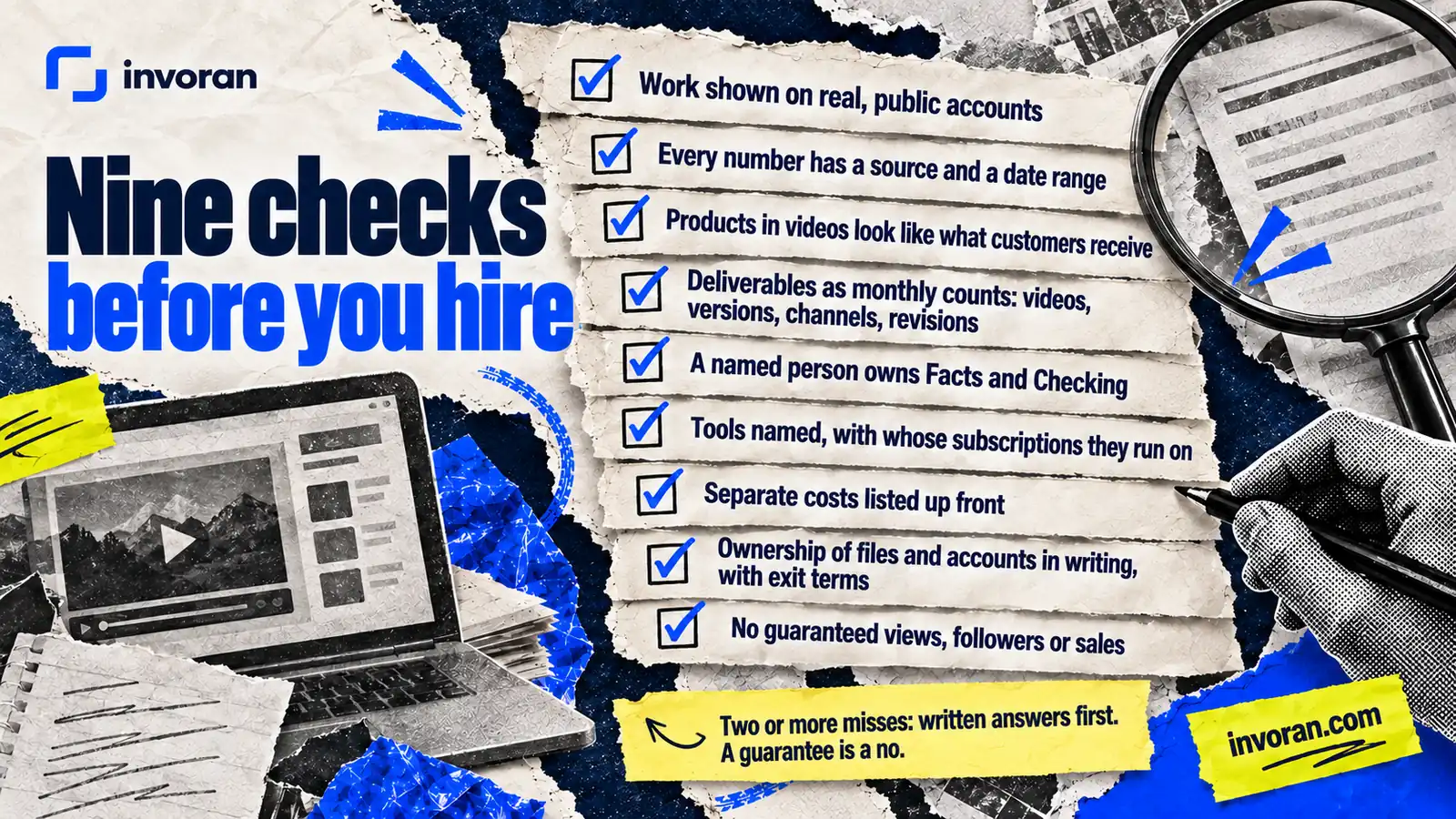
- [ ] Work is shown on real, public accounts, not only in a showreel.
- [ ] Every number quoted has a source and a date range.
- [ ] The products in the videos look like the ones customers receive.
- [ ] Deliverables are listed as monthly counts: videos, versions, channels, revisions.
- [ ] A named person owns Facts and Checking on the Creative Chain Map.
- [ ] Tools are named, with whose subscriptions they run on.
- [ ] Separate costs (ad spend, tool subscriptions, licenses) are listed up front.
- [ ] Ownership of files, channel accounts and ad accounts is written down, with clear exit terms.
- [ ] There is no guaranteed number of views, followers or sales.
Two or more misses mean written answers before you go further. A guarantee is a no.
What does an AI creative agency cost, and what changes the price?
AI creative agencies usually price per asset, per project or as a monthly retainer. Quotes look far apart because each agency puts different things inside the number.
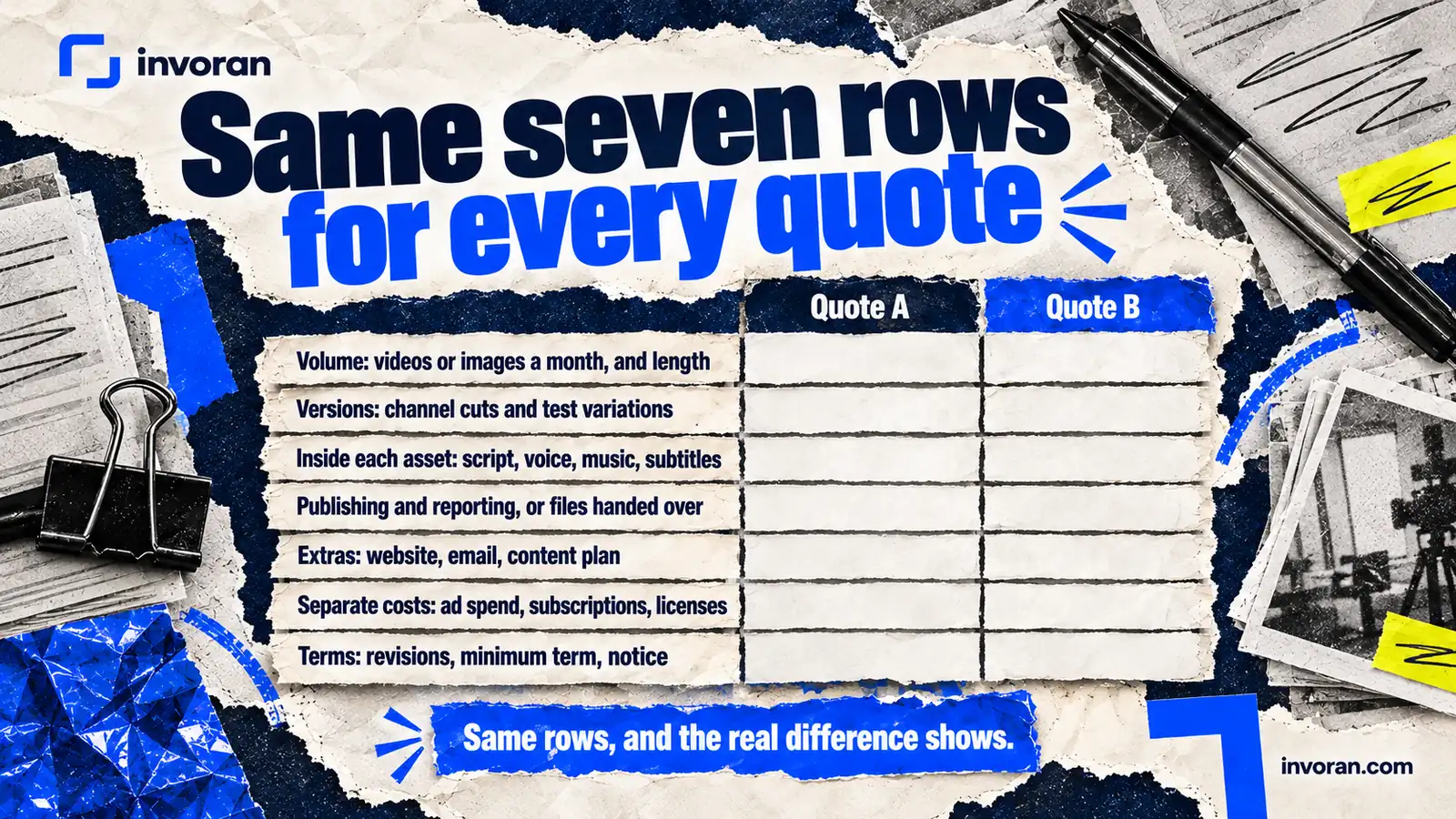
Compare them line by line:
- Volume: finished videos or images a month, and their length.
- Versions: channel cuts and test variations per idea.
- What's inside each asset: script, voice, music and subtitles, or only the edit.
- Publishing and reporting: posted and reported, or files handed over.
- Extras: website, email or a content plan.
- Separate costs: ad spend, tool subscriptions, licenses, domain and hosting.
- Terms: revision rounds, minimum term and notice.
A low per-video price can turn expensive once versions, captions and publishing are billed separately. Put every quote into the same seven rows and the real difference shows.
What rules should an AI creative agency already know in 2026?
The responsibility stays with you as the advertiser, but a good agency builds these in.
- US, truthfulness: announcing Operation AI Comply on September 25, 2024, the FTC's then-chair said using AI tools to trick, mislead or defraud people is illegal and that there is no AI exemption from the laws on the books.
- US, fake testimonials: the FTC's rule on reviews and testimonials, announced in August 2024, covers testimonials that misrepresent that they come from someone who doesn't exist, including AI-generated fake reviews. An AI avatar posing as a real customer is the obvious risk (see my guide to AI UGC ads).
- Copyright: the U.S. Copyright Office concluded in January 2025 that AI outputs are protectable only where a human author has determined sufficient expressive elements; prompts alone are not enough.
- United Kingdom: the ASA wrote in May 2025 that the advertising Codes have no AI-specific rules and there is no blanket legal requirement to disclose AI use in ads; existing rules apply however content is made, and a disclosure alone is very unlikely to fix a fundamentally misleading message, such as an AI image showing a cosmetic effect the product doesn't deliver.
- European Union: Article 50 of the EU AI Act applies from August 2, 2026. Deployers must disclose deepfakes clearly, at the latest at a viewer's first exposure.
- Platforms: YouTube, Meta and TikTok each require creators to disclose or label realistic AI-generated or AI-altered content in their posts (on Meta, the requirement covers photorealistic video and realistic-sounding audio). Check each platform's ad policy as well before a paid placement.
- Tool licenses: as of October 14, 2026, the free plans of ElevenLabs and Suno don't include commercial rights, so their audio doesn't belong in an ad.
The UK point is the one buyers miss: a label is not a fix. If the AI version of your product looks better than the real one, the ad is the problem.
When is an AI creative agency the wrong choice?
An AI creative agency is probably the wrong fit when:
- The person or place is the message. A founder's story, a real venue or a live event usually needs a camera.
- The real need is operations. For a chatbot, lead routing or an internal assistant, talk to an automation agency.
- Someone on your team should own creative long term. Then hands-on AI training for your team may fit better: one to four people learn to brief, generate and check on your own products.
- Nobody can supply facts or approve on time. Every agency stalls without accurate product information and a person who signs off.
- You need guaranteed growth. No honest agency can promise it; platforms decide distribution and buyers decide purchases.
Otherwise, if you want creative made and published every month without hiring for it, an AI creative agency is a reasonable choice. For the wider picture, see how to use AI in marketing.
Frequently asked questions
What is an AI creative agency?
An AI creative agency is a studio or team that produces marketing creative with generative AI tools. It typically makes short videos, images, ad variations and copy around your real product, and often publishes them too. People still own the idea, the product facts and the final check; AI mainly speeds up the making.
What does an AI agency do?
An AI agency uses AI tools to make marketing content, build automated systems or run paid campaigns, and the label covers at least four kinds of business. An AI creative agency makes the content. A traditional creative agency uses AI for some steps. An automation agency builds chatbots and workflows. An AI ad agency runs paid campaigns.
What is an AI-first marketing agency?
An AI-first marketing agency uses AI tools as its default way of producing work and brings in filming or human voice only when a job needs it. In practice that should mean fewer handoffs, cheaper changes and more versions to test. It doesn't mean guaranteed results or that no people are involved.
Do ads made with AI need to be labeled?
Sometimes, depending on the platform and the market. YouTube, Meta and TikTok require creators to disclose realistic AI content in posts, and paid placements also follow each platform's ad policy. The EU AI Act requires clear deepfake disclosure from August 2, 2026. The UK has no blanket AI disclosure rule, and a label won't fix a misleading ad.
Who owns the creative an AI agency makes?
Ownership depends mainly on your contract, so put it in writing before work starts. The U.S. Copyright Office has said prompts alone don't make an AI output protectable, while human-written scripts, arrangement and editing can be. Make sure finished files, channel accounts and ad accounts stay under your control.
The bottom line: hire the people behind the tools
Every AI creative agency has roughly the same tools. What you're hiring is the judgment at the two links AI can't own, Facts and Checking, plus a scope you can read in numbers. Fill in the Creative Chain Map for each agency on your shortlist and sign with the one that leaves no blank cells.
Send me a message on WhatsApp; the first 15 minutes are free.
Sources (accessed October 14, 2026)
- FTC — Crackdown on deceptive AI claims and schemes (Operation AI Comply) (September 25, 2024)
- FTC — Final rule banning fake reviews and testimonials (August 2024)
- U.S. Copyright Office — Copyright and Artificial Intelligence, Part 2: Copyrightability (January 29, 2025)
- ASA — Disclosure of AI in advertising (May 29, 2025)
- European Commission — Article 50 AI Act transparency FAQ
- YouTube Help — Disclosing altered or synthetic content
- Meta — Labeling AI-generated images on Facebook, Instagram and Threads (February 2024 announcement)
- TikTok — AI-generated content transparency
- ElevenLabs pricing and Suno pricing
- Invoran — AI content and video and About
- Pratik10 Instagram account data, October 2026 (internal).