Last updated: October 14, 2026
An AI certification is worth it when someone specific will ask for the paper: a job posting that names it, an employer that requires it, or a client file that lists it. It is rarely worth it as proof that you use AI well, because a certificate shows you finished a course or passed an exam, not that your output is any good. The best salary data I have found points the same way: certificate holders earn more, but the researchers say plainly that the gap is a correlation, not evidence that the certificate caused it.
Before anyone pays for a program, I run what I call the Paper-or-Proof test: who will ask for this paper, and what proof of my own work will I have when the program ends?
In short:
- If you need paper: get the exact credential the posting, employer or client names, and ask how they will verify it.
- If you need proof: judge a program by the work you will have at the end, built on your own tasks.
- For managers and HR: the European Commission says the EU AI Act's AI literacy duty does not require a certificate; organizations can keep an internal record of who was trained instead.
- Start free: Google's introductory generative AI course, announced at no cost, covers the basics first.
What counts as an AI certification?
"AI certification" is used for documents that prove very different things: that you attended, that you passed a proctored exam, or that you finished a short learning path. "Is this course certified?" is the wrong first question. The better one: what does this document prove, and to whom?
| Type | Who issues it | What it proves | Cost | Watch out for |
|---|---|---|---|---|
| Certificate of completion | Course platforms, software companies' learning academies | You finished the course | Free to paid | Ask who recognizes it before you enroll |
| Exam-based certification | Tech vendors such as AWS and Microsoft | You passed a proctored exam on a published skills list | Exam fee | Usually tied to that vendor's cloud; some expect coding |
| Digital or skill badge | For example, Google Cloud | You finished a course or learning path | Often no cost | Short and introductory by design |
| University certificate | Continuing education units, graduate programs | You completed a structured program | Paid; varies widely | Ask how much of it is hands-on |
| Hands-on team training | A trainer or consultant | Nothing by itself; the proof is the team's own work | Paid | Not a certification; ask whether any document is issued |
I left out prices on purpose: they change by provider and month, so get the total fee, hours and tool costs in writing.
Is AI certification worth it? The Paper-or-Proof test
The test has two questions. First: who will ask for this paper, and why? If the answer is a named posting, employer, client or contract, you need paper.
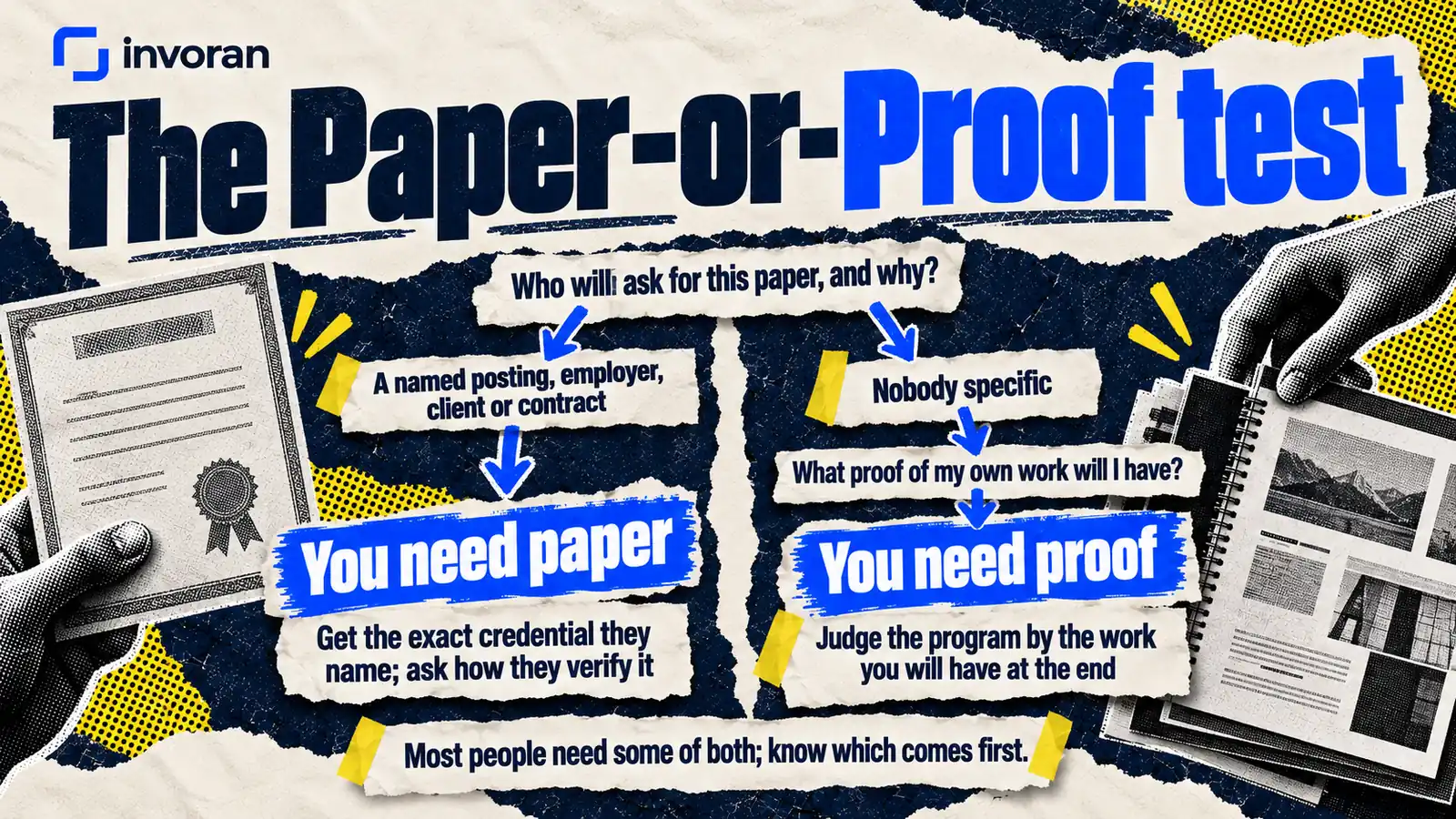
Second: what proof of my own work will I have when it ends? If your goal is to use AI in your job, this answer matters more. Most people need some of both; the point is to know which comes first.
If you are deciding for your own career
Most people searching this want to know: will it help me get hired or promoted? Only when the person reading your application already knows and trusts that credential. Paper can't show whether your AI-assisted work is accurate, on brand and finished; samples do.
| Situation | Is a certificate worth it? | What to do |
|---|---|---|
| A job posting or employer names a specific credential | Yes | Get that exact credential, not a similar one |
| You are switching careers and have no AI work on your resume | Partly | Pair the certificate with at least two work samples |
| You are a marketer who wants to stand out | Rarely on its own | Show a campaign, email or script you made with AI and checked |
| You want to save time on repeated work | No | Time one repeated task before and after |
Before you buy an AI marketing certification, read ten job postings you would actually apply for and list every credential they name. If several name the same one, that is your paper. If none do, your money goes further on proof.
A representative example: a marketing coordinator at an e-commerce brand is told to "get an AI certification." She runs the test. Who will ask for the paper? Nobody specific. What proof does she need? Her manager wants faster product descriptions and campaign emails. She takes a free introductory course, then rewrites five product pages with AI and shows the before and after with her checklist. This is a representative example, not a client result.
If you are deciding for a team
Managers and HR teams ask a different question: pay for certificates, or for something else?
| Situation | Is a certificate worth it? | What to do |
|---|---|---|
| A client or procurement questionnaire asks for training evidence | Usually | Read the wording and ask which documents they accept |
| Your team is about to use AI in its own work | Not on its own | Choose hands-on training built on the team's real tasks |
| You are deciding whether AI is worth investing in | Usually not | Run a short pilot on one real task and measure it |
| Your company falls under the EU AI Act's AI literacy duty | Not required | Keep a record of who was trained, on what and when |
What does the salary data actually show?
The strongest evidence I found comes from Revelio Labs, a workforce data company. In a June 23, 2026 analysis of AI certifications on workers' online professional profiles, it found that, controlling for occupation and seniority, holders earn on average an $8,000 salary premium over non-holders. At their next job move, 38.9% of certification takers landed a higher-seniority role, against 32.5% of a matched group that did not certify.
The authors' own caveats:
- People who certify already earn more than their peers in most occupations, and the matching does not fully remove that gap.
- Part of the mobility advantage may reflect the ambition of people who choose to certify, not the certificate.
- The results are correlations, not causal effects.
- The certifications are mostly broad, entry-level credentials.
My reading: the premium may say as much about the kind of person who collects certificates, people already learning and already moving, as about what a certificate does for you. If you hope the document alone will add $8,000 to your salary, the data does not support that.
Which AI certifications are worth it for which goal?
There is no single list of the best AI certifications, because "best" depends on whose paper you need.
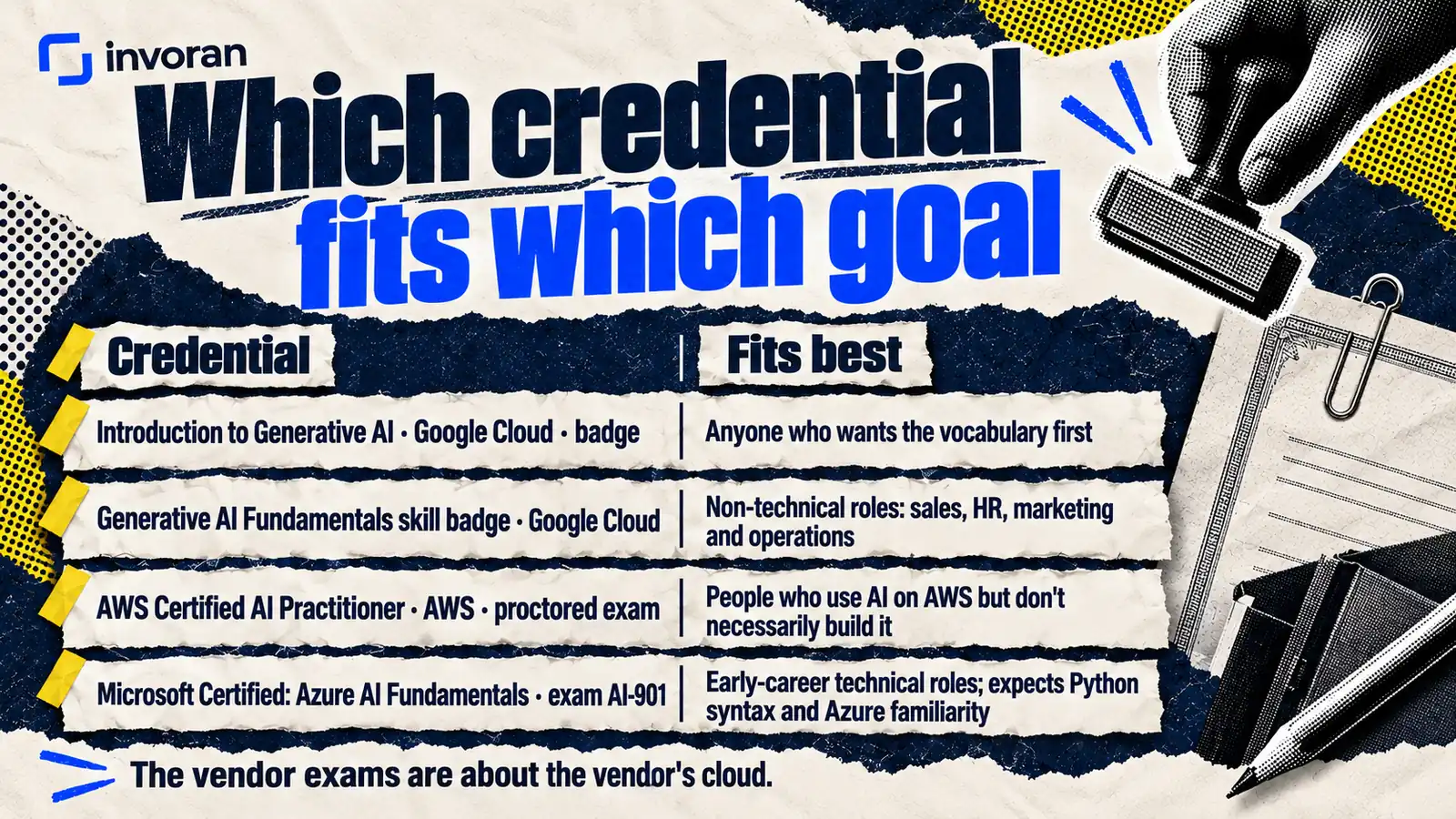
Here are four widely known options, with what each issuer's own page showed on October 14, 2026:
| Credential | Issuer | What it covers | Cost and format | Fits best |
|---|---|---|---|---|
| Introduction to Generative AI | Google Cloud | What generative AI is and how it differs from traditional machine learning; about 45 minutes; badge listed on the course page | Announced as no-cost in September 2023; check the current page | Anyone who wants the vocabulary first |
| Generative AI Fundamentals skill badge | Google Cloud | The course above plus introductions to large language models and responsible AI; about two hours | Announced as no-cost in September 2023 | Non-technical roles; Google described its introductory generative AI learning path as designed for sales, HR, marketing and operations |
| AWS Certified AI Practitioner | AWS | Foundational AI, machine learning and generative AI on AWS; 65 questions in 90 minutes | 100 USD exam; test center or online proctored; valid three years | People who use AI on AWS but don't necessarily build it |
| Microsoft Certified: Azure AI Fundamentals | Microsoft | AI workloads, machine learning, vision, language and generative AI on Azure, via exam AI-901 (updated April 15, 2026) | Price depends on the country where you take the exam | Early-career technical roles; expects Python syntax and Azure familiarity |
The vendor exams are about the vendor's cloud: Microsoft expects Python syntax, a fair bar for an engineer and a strange one for a content marketer. The free Google path, aimed at marketing and sales roles, is short, which makes it a good first step and a weak differentiator.
How do you verify an AI certification before you trust it?
Anyone can make a PDF. A certificate is only useful when the reader can check it without asking you.
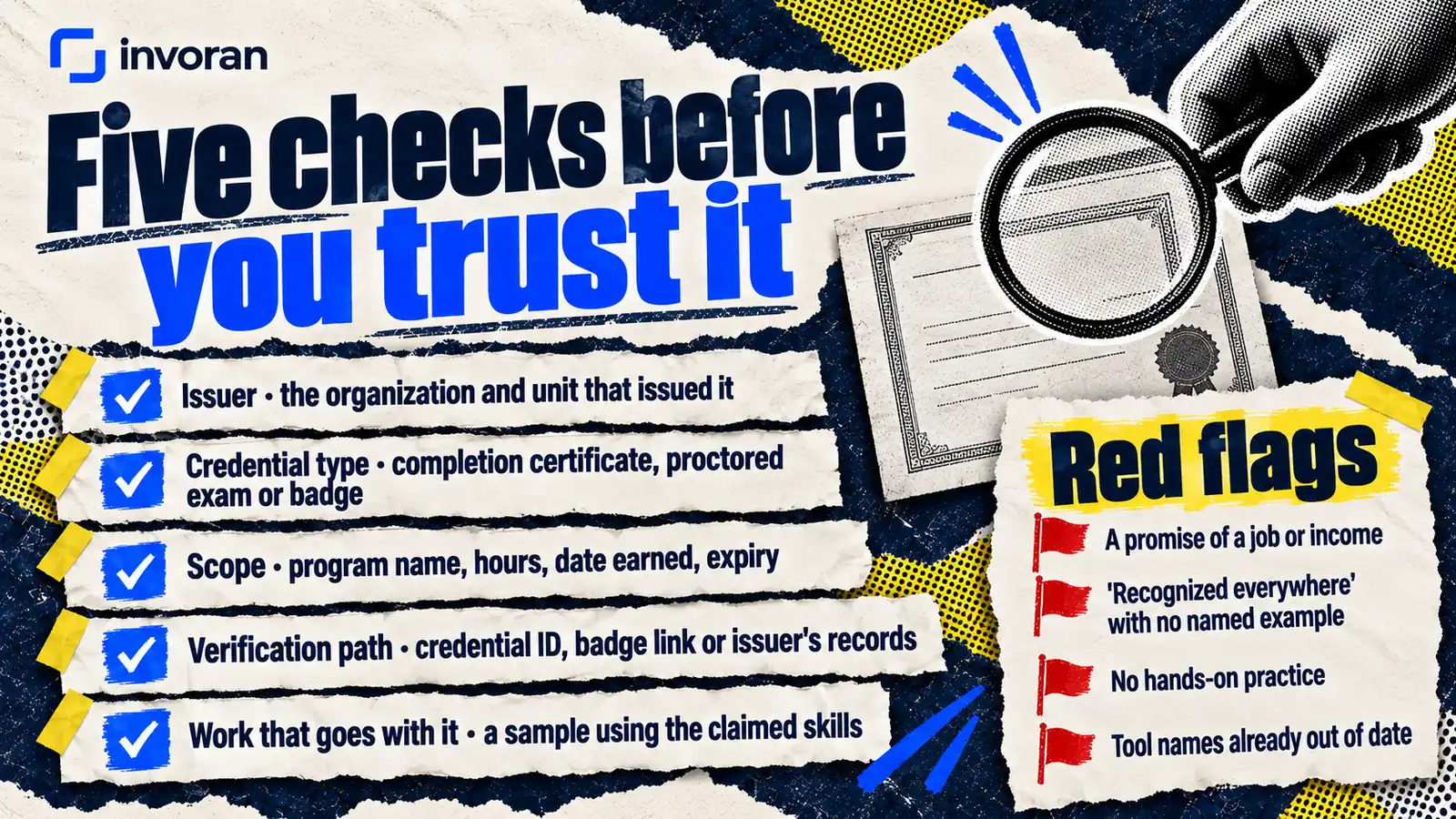
Whether you are choosing a program or reviewing a resume, check five things:
| Check | What to look for | Why it matters |
|---|---|---|
| Issuer | The organization and the unit that issued it | The reader decides whether they recognize it |
| Credential type | Completion certificate, proctored exam or badge | Attendance or a measured level |
| Scope | Program name, hours, date earned, expiry if any | "AI training" as a title says nothing about content |
| Verification path | A credential ID, a badge link or the issuer's own records | The reader can confirm it was really issued |
| Work that goes with it | A sample made with the skills it claims | The answer to "How did you do this?" lives here |
Verification differs by issuer, so ask the provider before you enroll, in writing: "How can an employer confirm this credential?" One detail from Microsoft is worth knowing for any vendor exam: it recommends registering with a personal account, because exam records tied to a work or school account are lost if you leave the organization.
Red flags: a promise of a job or income, a claim that the credential is "recognized everywhere" with no named example, no hands-on practice, and tool names already out of date. For a whole team, my AI upskilling program guide lays out an hour-by-hour plan.
Should companies require AI certification for employees?
Usually not. A company needs people who can use AI correctly and safely in their own work. The clearest official statement comes from the European Union:
- EU AI Act, Article 4: providers and deployers of AI systems (deployers are organizations that use them in their work) must take measures to support their staff's AI literacy. According to the European Commission, the article has applied since February 2, 2025.
- No certificate needed: the Commission's FAQ says there is no need for a certificate; organizations can keep an internal record of trainings and other initiatives.
- After the Digital Omnibus: the amendments entered into force in mid-July 2026. According to the Commission's page, updated July 27, 2026, AI literacy remains an obligation for providers and deployers, with no specific level required.
- Reach beyond the EU: the Act applies inside and outside the EU where AI systems are placed on the EU market, used in the EU, or affect people in the EU. A US or UK company selling into Europe should check whether that covers it.
Instead of collecting certificates, keep a simple record: who was trained, when, on which tasks and tools, which workflows now use AI, and who checks the output. It answers an internal review or a client's "How do you use AI?" better than a folder of certificates. Goals work the same way: "half the team gets certified" measures paper; "AI is used in two repeated tasks, each with a named checker" measures proof.
Before you pay for team training of any kind, get written answers to four questions:
- [ ] Whose tasks? Will people practice on your own products, customers and copy, or on generic examples?
- [ ] What stays behind? What will each person have at the end: prompts, drafts, a checklist, a workflow?
- [ ] Who checks the output? Is reviewing AI output part of the exercises, and who owns it afterwards?
- [ ] Which document, if any? If one is issued, who recognizes it and how can it be verified?
My hands-on AI training is built around the first three: it runs online for one to four people, every exercise comes from your own work, and participants leave with prompts, drafts and checking steps they can reuse. I don't issue a certificate or an attendance document, so if you need paper, one of the programs above is the better choice.
How do you prove AI skills without a certificate?
Build a proof file: real work plus the habit of keeping notes.
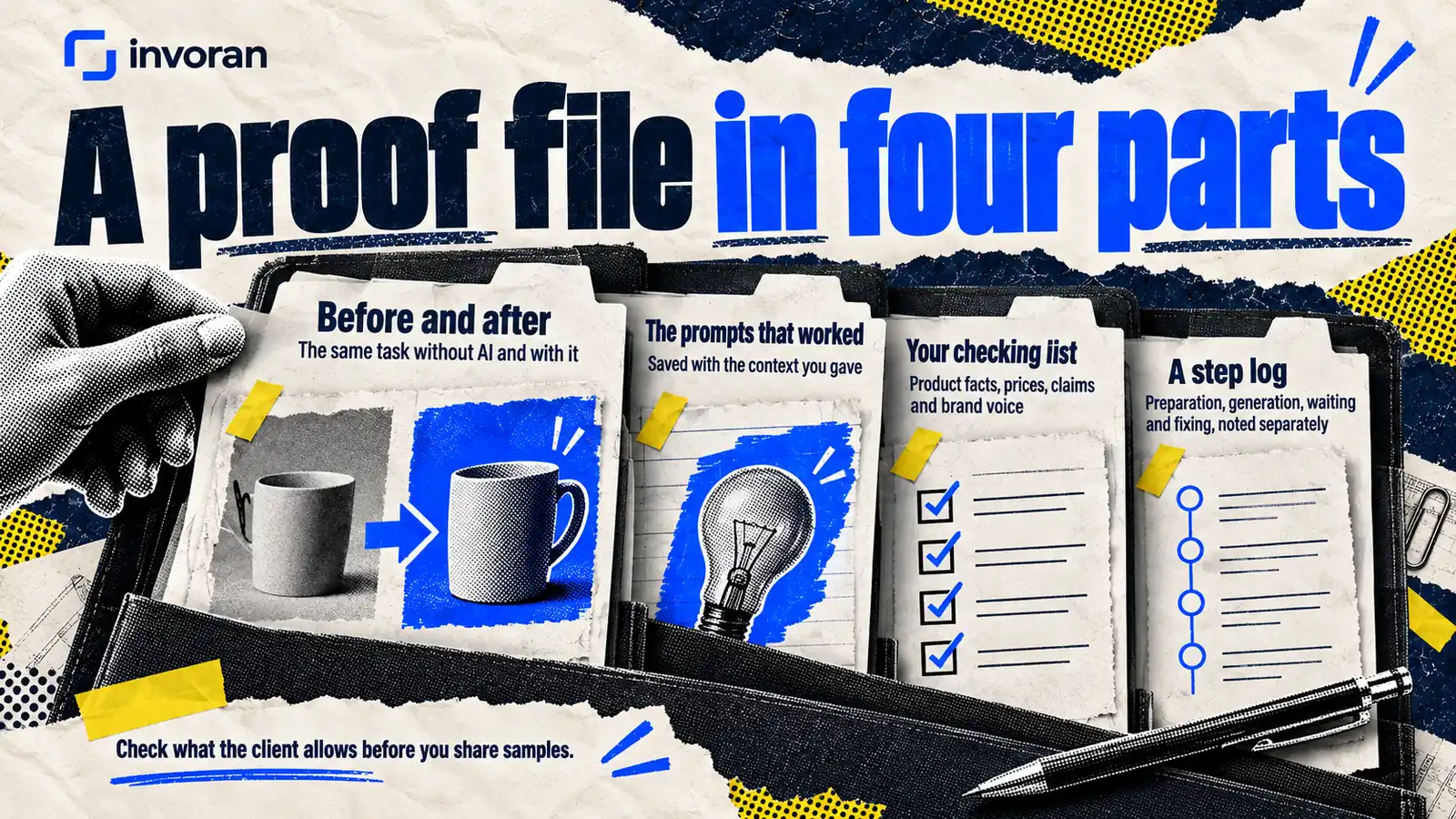
It has four parts:
- [ ] Before and after: the same task without AI and with it, such as a product description's first draft and the version that went live.
- [ ] The prompts that worked: saved with the context you gave: who it is for, what it should do, what it must not use, how you will check it. My AI prompt template guide has copyable versions.
- [ ] Your checking list: what you verify before anything AI-made goes out: product facts, prices, claims and brand voice.
- [ ] A step log: preparation, generation, waiting and fixing, noted separately. Time often disappears in the last two.
I show results the same way, with records instead of paper. On the Instagram account of Pratik10, one of the brands I work with, the four most-viewed posts reached 2.1K, 2.1K, 940 and 584 views, and all four open with a question (account data, October 2026). That is one account's limited data, not a guarantee, and it says nothing about AI on its own. The point is the format: a dated record of what was done and what happened, which a completion certificate cannot show. Before you share your own samples, check what the client allows, or use an invented product or a public page.
To weigh a course against an agency or a consultant, see AI marketing consultant vs. agency vs. course; for where AI fits across marketing, see how to use AI in marketing.
Frequently asked questions
Are AI certifications worth it for marketers?
AI certifications are worth it for marketers mainly when a posting, employer or client names a specific one. Otherwise, a free introductory course plus a proof file of real work is usually the better investment. Be ready to show campaigns, emails or scripts you made with AI and checked yourself.
Do AI certifications increase your salary?
AI certification holders earn more on average, but the data does not show that the certificate causes it. Revelio Labs found an $8,000 average premium after controlling for occupation and seniority, yet its authors note that people who certify already earned more and call the results correlations, not causal effects. Treat a certificate as a signal, not a raise.
Are free AI certifications worth it?
Free AI certifications are worth it for learning the basics and showing that you have started. Google Cloud's introductory generative AI course was announced at no cost and takes about 45 minutes. Because anyone can earn such badges quickly, they rarely set you apart; add work samples that show you can apply what the course taught.
Do employees need an AI certificate under the EU AI Act?
No, employees do not need an AI certificate under the EU AI Act. Article 4 asks providers and deployers of AI systems to support their staff's AI literacy, and the European Commission states that no certificate is needed. Organizations can keep an internal record of trainings instead. Check with a lawyer whether, and how, the Act applies to your company.
How long does it take to get an AI certification?
It depends on the credential. Google's introductory generative AI course takes about 45 minutes. The AWS Certified AI Practitioner exam itself lasts 90 minutes, plus your preparation time. University certificate programs are structured courses and usually take much longer. Look at what you will be able to do afterwards, not only the hours.
Should I choose a certification or hands-on training?
Choose a certification when you know who will ask for the paper, and hands-on training when you want to use AI in your own work. For most people the best order is a free introductory course for the vocabulary, then practice on real tasks with someone reviewing the output.
The bottom line: ask the question before you pick the program
Is AI certification worth it? Run the Paper-or-Proof test. If a posting, employer or client asks for a credential, get the one they recognize and can verify. If the goal is to use AI in your job, judge every program by the proof it leaves you: start free, then practice on real work.
Send me a message on WhatsApp; the first 15 minutes are free.
Sources (accessed October 14, 2026)
- Revelio Labs — Are AI Certifications Worth It? (June 23, 2026)
- Google Cloud Blog — New generative AI trainings from Google Cloud (September 13, 2023)
- Google Skills — Introduction to Generative AI
- AWS — AWS Certified AI Practitioner
- Microsoft Learn — Microsoft Certified: Azure AI Fundamentals
- European Commission — AI Literacy: Questions & Answers (last updated July 27, 2026)
- Invoran — AI training
- Pratik10 Instagram account data, October 2026 (internal).